
Free AI for Research Paper Writing: How to Use Acade from Topic to Draft
Acade Team · July 30, 2026
Research paper writing is not a single writing task. Before drafting, you need to turn a broad topic into a focused question, find relevant literature, compare evidence, choose a defensible method, and decide what your paper can reasonably claim. After drafting, you still need to verify sources, review the argument, and comply with your institution’s or journal’s AI policy.
A free AI tool can reduce some of this work—but only when it supports the research process instead of producing unsupported prose.
Acade is an AI-powered academic research workspace for students, researchers, and professionals. Its Super Agent connects tasks such as topic selection, literature research, research design, note organization, outlining, data analysis, drafting, translation, and academic polishing.
Acade also offers a $0 Free plan, making it possible to start a research paper workflow without payment. This guide explains what the free plan includes, how to assign a research task to Acade, where human review remains essential, and how to use AI without compromising academic integrity.
Quick answer: Is Acade free for research paper writing?
Yes. At the time of our check on July 30, 2026, Acade’s Free plan cost $0 and required no payment. The plan included:
1,000 credits
Unlimited writing access
The Lite model
Deep Research
The Acade Super Agent
AI-assisted writing
100 MB of cloud storage
The Free plan did not include Acade’s built-in citation feature or knowledge base. It also did not allow users to purchase additional credit packages.
“Unlimited writing” should not be interpreted as unlimited use of every AI research capability. Model- and agent-powered tasks may consume credits, and the Free plan includes 1,000 credits. Pricing and plan features can change, so check the current information inside Acade before choosing a plan.
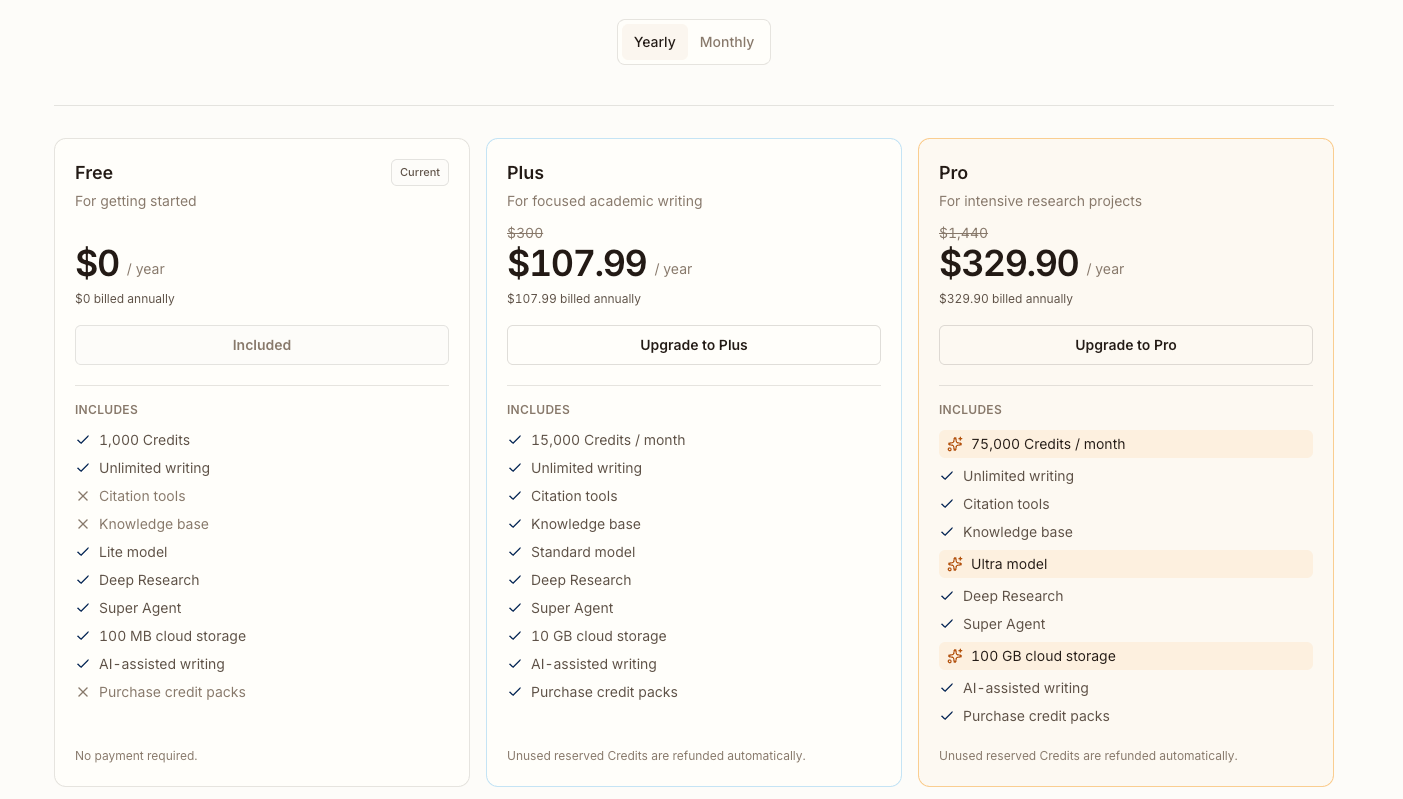
Figure 1. Acade’s annual pricing view during our public-page check on July 30, 2026. The Free plan was listed at $0 with 1,000 credits. Recheck pricing before publication and update the fact-check date when the page changes.
What we verified on Acade’s public interface
To keep this guide grounded in observable product behavior, we accessed Acade’s public workspace and performed a limited interface check on July 30, 2026.
We verified that the workspace visibly provides:
A natural-language research task box
Agent and Fast modes
Literature Tools, Paper Writing, and Research Work capability menus
Dedicated Paper Writing and Library areas
Example tasks for literature search, research-gap exploration, outlining, polishing, translation, systematic review, DOI-based literature download, data analysis, mind mapping, mixed-methods research design, and questionnaire design
We then entered this research task:
Help me investigate how generative AI affects critical thinking among undergraduate students. Refine the research question, plan the literature search, identify evidence gaps, recommend a research design, and create a paper outline.
The interface accepted the full task and enabled submission. Because the public session was not signed in, we did not submit the task or evaluate a generated result during this check. The example workflow later in this article is therefore based on the verified interface and Acade’s documented capabilities—not a claim that a particular output was generated in this public test.
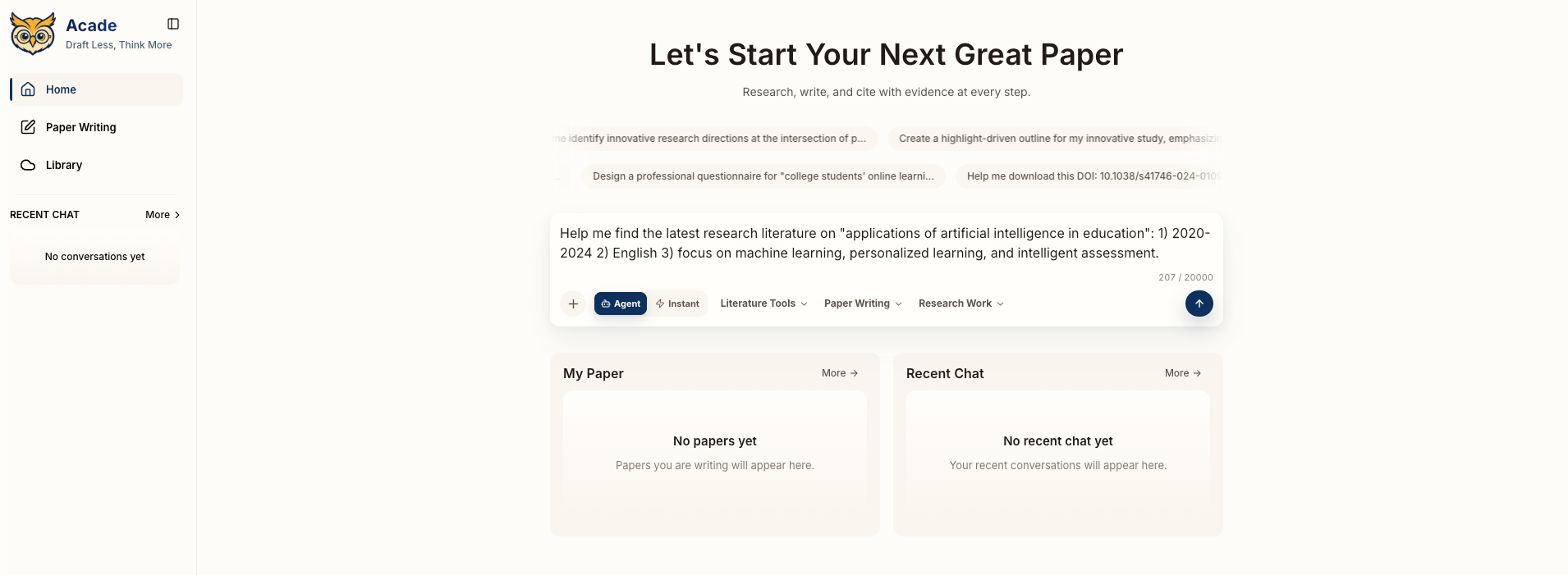
Figure 2. A real research task entered into Acade’s public interface. The screen also shows Agent/Fast modes and the Literature Tools, Paper Writing, and Research Work menus.
Why an academic research agent is different from a one-prompt paper generator
A generic paper generator usually treats the request as a text-completion problem: you provide a title, and it produces paragraphs. That can create fluent writing without a transparent connection between the research question, evidence, method, and conclusion.
An academic research workflow is different. It breaks the project into connected decisions:
What exactly is the research problem?
What has already been studied?
Which evidence is relevant?
Where do findings agree or conflict?
What research gap is defensible?
Which method can answer the question?
How should the evidence be organized?
Which claims require citations?
What must the researcher verify?
Acade’s product scope covers these connected stages, including topic selection, research design, literature search and legally available downloads, translation, notes, mind maps, outlines, literature reviews, questionnaires, data analysis, research reports, drafting, and academic polishing.
The goal is not to remove the researcher from the process. It is to reduce repetitive work while keeping factual verification, methodological judgment, interpretation, and final authorship with the human researcher.
How to use free AI for research paper writing
Step 1: Give Acade a research task, not just a paper title
Avoid starting with:
Write a research paper about generative AI in education.
This instruction does not define the population, outcome, period, type of evidence, or intended contribution.
Use a task that includes:
The broad subject
The population or context
The paper type
The decision you need help making
Relevant time or geographic boundaries
The intended output
For example:
I am preparing an undergraduate research proposal about generative AI and critical thinking in higher education. Help me narrow the topic, identify relevant concepts, propose a feasible research question, plan a literature search, and create a research proposal outline. Do not invent references. Mark anything that requires manual verification.
This tells the agent to begin with research planning rather than premature drafting.
Step 2: Refine the research question
A research question should be specific enough to guide the literature search and method.
Ask Acade to assess:
Clarity
Scope
Feasibility
Population
Variables or themes
Time frame
Possible contribution
Example:
Evaluate this question for clarity, scope, and feasibility: “How does generative AI affect student learning?” Identify ambiguous terms and propose three narrower versions suitable for an undergraduate study.
A possible refinement might focus on how a defined form of AI use relates to a measurable critical-thinking outcome among a specified student population. The final question must still be chosen by the researcher.
Step 3: Plan the literature search
Acade can help turn the research question into concepts, synonyms, related terms, and search combinations.
For the example topic, a search plan might include:
Ask for database-ready search strings and clear inclusion and exclusion criteria:
Create a literature-search plan for peer-reviewed empirical studies about generative AI use and critical-thinking outcomes among university students. Include concept groups, synonyms, Boolean search strings, date limits, inclusion criteria, exclusion criteria, and fields to extract from each study.
Run the searches in appropriate scholarly databases and document the database, query, date, filters, and number of results. AI-generated search suggestions do not prove that the literature search is complete.
Step 4: Organize and compare the literature
Instead of asking for a chain of unrelated summaries, ask Acade to organize verified papers into an evidence table.
Useful fields include:
Full citation
Research question
Country and context
Sample
Method
Variables or themes
Main findings
Limitations
Relevance to your question
Then ask:
Compare these verified studies. Identify findings that agree, findings that conflict, differences in methods or samples that might explain the disagreement, and questions the existing evidence does not answer. Base the analysis only on the materials I provide.
Acade can also help organize research notes and relationships into a structured mind map. This is different from claiming that it automatically produces a bibliometric citation-network map.
Step 5: Identify a defensible research gap
A research gap is not simply a topic that sounds new.
Potential gaps may involve:
Conflicting results
An overlooked population
A limitation shared by existing studies
A missing comparison
An untested mechanism
A theory not examined in a particular context
A change that makes older evidence less applicable
Use a verification-focused prompt:
Based only on this evidence table, identify possible empirical, theoretical, methodological, and contextual gaps. For each proposed gap, name the supporting studies, explain the reasoning, and state what additional literature searching is needed before the gap can be treated as established.
Treat every suggested gap as a hypothesis about the literature until you verify it with a sufficiently broad search.
Step 6: Plan the research design
Acade can assist with research objectives, hypotheses, population, method, data sources, variables, implementation steps, and analysis plans.
For example:
Compare three feasible methods for answering this research question: a cross-sectional survey, a quasi-experiment, and a mixed-methods study. For each option, explain the data required, strengths, limitations, ethical considerations, and the conclusions the design would and would not support.
The researcher must confirm that the proposed method actually answers the question. Human-subject research, medical research, sensitive data, and formal experiments may require supervisor, institutional, statistical, or ethics review.
Step 7: Build an evidence-based outline
Ask Acade to link every major section to a purpose and an evidence requirement.
A research-paper outline may include:
Introduction
Problem statement
Literature review
Research gap
Research question or hypotheses
Method
Results
Discussion
Limitations
Conclusion
Example prompt:
Create a detailed research-paper outline based on my verified sources, research question, and proposed method. For every section, state its purpose, the evidence it requires, and which of my sources may support it. Do not add a citation unless it appears in the source list I provide.
Step 8: Draft section by section
Do not ask AI to produce the entire paper in one pass. Drafting section by section makes it easier to check evidence, logic, terminology, and repetition.
For each section, provide:
The approved outline
The section objective
Verified sources
Your own analysis or findings
Length and style requirements
Claims the system must not make
Example:
Draft a 700-word literature-review section using only the attached evidence table and my notes. Compare the studies by theme rather than describing them one at a time. Mark any statement that lacks direct source support with [SOURCE NEEDED].
Acade can help turn researcher-provided ideas and evidence into clearer prose. It should not replace the researcher’s interpretation or contribution.
Step 9: Analyze data with human oversight
Where relevant, Acade can assist with data organization, descriptive analysis, comparisons, trend identification, visualization, and drafting explanations of results.
Provide:
Variable definitions
Data provenance
Missing-value rules
Analysis objective
Expected output
Known limitations
Ask the agent to separate:
Observed results
Statistical interpretation
Possible explanations
Unsupported speculation
Review the analysis method, code, assumptions, calculations, and conclusions independently. Never allow AI to invent missing observations, survey responses, interview quotations, clinical data, or experimental results.
Step 10: Polish the manuscript without changing its meaning
Acade can help improve accuracy of expression, coherence, professional tone, and readability while preserving the intended meaning.
Use a controlled prompt:
Improve the clarity and academic tone of this section without adding facts, citations, results, or stronger causal claims. List any sentence whose meaning may have changed.
Language polishing should come after evidence and logic review. Fluent wording cannot repair an unsupported argument.
A practical Acade workflow for one research task
The following is an example workflow—not a reproduced output from our logged-out public-page check.
Starting task
Investigate how generative AI affects critical thinking among undergraduate students. Help me refine the question, plan the literature search, organize verified studies, identify evidence gaps, compare research designs, and build a paper outline. Clearly separate evidence from inference.
Expected researcher–agent workflow
The researcher defines the academic level, deadline, field, and paper type.
Acade helps narrow the question and identify ambiguous concepts.
Acade proposes a literature-search structure.
The researcher obtains and verifies the original papers.
Acade organizes the selected papers by method, finding, and limitation.
Acade suggests candidate research gaps.
The researcher searches further to test whether the gaps are real.
Acade compares feasible research designs.
The researcher selects and validates the method.
Acade creates an evidence-linked outline.
The researcher and Acade develop sections iteratively.
The researcher verifies every claim, citation, result, and conclusion.
This workflow reflects Acade’s role as a research collaborator. It does not imply that an AI system can independently guarantee an original, accurate, ethical, or publication-ready paper.
Acade Free vs. Plus vs. Pro
At the time of our July 30, 2026 check, Acade displayed the following annual plans:
The pricing page also indicated that unused scheduled credits on Plus and Pro are automatically returned. Refer to Acade’s current plan terms for the exact operation of credits, billing, refunds, and feature availability.
What Acade cannot decide for you
Acade can assist with research and writing tasks, but the researcher remains responsible for:
Confirming that every source exists
Reading the original literature
Checking whether a source supports the claim
Selecting an appropriate method
Obtaining required ethics approval or consent
Protecting confidential and personal data
Verifying analyses and calculations
Interpreting results
Ensuring originality
Following institutional and publisher policies
Disclosing AI use when required
Approving the final manuscript
The International Committee of Medical Journal Editors states that humans are responsible for reviewing AI-assisted content and ensuring its accuracy; AI tools should not be listed as authors, and use of AI should be transparent. Its guidance also warns that AI output may be incorrect, incomplete, or biased. See the ICMJE recommendations on AI in publishing.
Elsevier similarly requires human oversight, source verification, and appropriate disclosure for permitted uses of generative AI. Its current journal policy states that AI tools must not replace scientific judgment, analysis, interpretation, or intellectual contribution. Always check the policy of the specific journal or institution governing your work. See Elsevier’s generative AI policies for journals.
For systematic reviews, PRISMA 2020 provides reporting checklists and flow-diagram templates. Using AI does not itself make a review PRISMA-compliant; researchers must follow the relevant reporting requirements. See the official PRISMA 2020 statement.
Responsible-AI checklist for research paper writing
Before submitting a paper developed with AI assistance, confirm that:
Every reference is real and accessible
Every citation supports the associated statement
Direct quotations are accurate
No data, result, interview, or experiment was fabricated
AI-generated suggestions are distinguished from evidence
Conclusions do not exceed the method or results
Confidential material was handled appropriately
The relevant AI policy was checked
AI use was disclosed when required
A human author reviewed and approved the final manuscript
Frequently asked questions
Is Acade free to use?
Yes. During our July 30, 2026 check, Acade offered a $0 Free plan with 1,000 credits. It included unlimited writing access, the Lite model, Deep Research, the Super Agent, AI-assisted writing, and 100 MB of cloud storage. No payment was required.
What are the limitations of Acade’s Free plan?
The Free plan did not include Acade’s built-in citation feature or knowledge base. It included 1,000 credits, and additional credit packages were not available on that plan. Some agent- or model-powered work may therefore be usage-limited even though writing access is described as unlimited.
Can I write an entire research paper with Acade for free?
Acade can help with connected stages including topic selection, research planning, literature research, outlining, drafting, and polishing. The amount of AI-assisted work available on the Free plan depends on credit use. Regardless of plan, the user remains responsible for sources, analysis, methodology, citations, originality, disclosure, and the final manuscript.
Does Acade’s Free plan include Deep Research?
Yes. Deep Research and the Acade Super Agent were shown as included in the Free plan during our check.
Does the Free plan include citations?
Acade’s built-in citation feature and knowledge base were shown as unavailable on the Free plan and included with Plus and Pro. Free users should verify sources and manage final references separately.
Can Acade help with a literature review?
Yes. Based on Acade’s documented capabilities and visible public task examples, it can assist with literature search, study organization, comparison of methods and findings, identification of possible gaps, and literature-review drafting. Researchers must still read original sources and verify interpretations and citations.
Is it ethical to use Acade for academic writing?
Ethical use depends on what the tool does, how transparently it is used, and the rules of the relevant institution, course, funder, or journal. AI should not be treated as an author, and the human researcher remains accountable. Check the applicable policy before beginning and again before submission.
Start with the research task you actually have
You do not need a perfect title or a finished methodology before you begin.
Tell Acade:
“Help me turn this broad topic into a focused, researchable question.”
“Organize these verified papers into an evidence table and show me where the findings disagree.”
“Compare feasible research designs and explain what each design can and cannot establish.”
“Turn my approved outline, sources, and notes into a structured first draft without adding unsupported claims.”
What research task would you like to move forward today?