
How to Write a Lab Report: Format, Steps and Examples

Written by Elena BrooksLast updated: August 5, 202627 min read

Quick Answer
To write a lab report, follow your assignment instructions, organize the original experiment notes and data, and explain the purpose, method, results, interpretation, and evidence-based conclusion. Keep Results focused on what was observed and Discussion focused on what the observations mean. Verify every value, unit, calculation, table, figure, and citation before submitting the report.
Requirements
→ Experiment purpose
→ Method
→ Data
→ Results
→ Interpretation
→ Conclusion
→ References
→ Final check
A typical lab report may contain:
Title
Abstract, when required
Introduction
Materials and Methods
Results
Discussion
Conclusion
References
Appendices, when required
The exact structure varies by course and discipline. Check the assignment prompt, lab manual, course rubric, department guide, and instructor instructions before drafting.
A short section example
The following is an illustrative teaching example, not a real research finding.
Result: The mean dissolving time decreased from 182 seconds at 20°C to 96 seconds at 40°C.
Discussion: The shorter mean time at 40°C is consistent with faster particle movement at the higher temperature, although variation in tablet size may also have affected the measurements.
The Results sentence reports the measured pattern. The Discussion sentence interprets it and identifies a limitation. Neither sentence invents data or claims more than the example supports.
Start Your Lab Report with Acade
Turn your experiment notes, methods, and results into a structured lab-report workflow while keeping control of your evidence and final conclusions.
Research smarter with Acade
One Academic Agent for literature search, research design, writing, and more.
Try Start free →What Is a Lab Report?
A lab report is a structured record and interpretation of an experiment. It explains why the experiment was conducted, what was done, what observations and data were collected, what the results show, how those results should be interpreted, and what conclusion can reasonably be drawn.
The purpose of a scientific lab report is not simply to repeat a procedure or prove that an expected answer was correct. A credible report makes the experimental record understandable and allows a reader to evaluate the connection between the method, evidence, interpretation, and conclusion.
A lab report commonly documents:
the scientific purpose or research question;
a hypothesis, when required;
variables, controls, materials, and procedure;
observations and experimental data;
calculations, tables, figures, and patterns;
interpretation based on scientific reasoning;
uncertainty, unexpected outcomes, and limitations; and
a conclusion proportional to the evidence.
Never fabricate or alter observations to make them support a hypothesis. An unexpected result is still part of the experimental record and may be scientifically informative.
What Should a Lab Report Include?
Section | Primary purpose | Main question answered |
|---|---|---|
Title | Identify the experiment | What was studied? |
Abstract | Summarize the complete report | What was done and found? |
Introduction | Explain purpose and context | Why was the experiment conducted? |
Materials and Methods | Describe what was done | How was the experiment performed? |
Results | Present observations and data | What was found? |
Discussion | Interpret the results | What do the findings mean? |
Conclusion | Answer the objective | What can reasonably be concluded? |
References | Document sources | Which sources support the report? |
Appendix | Provide supplementary material | What additional information is needed? |
Not every course uses these exact names or this order. Some combine Results and Discussion, omit the abstract, or integrate the conclusion into the Discussion. The assigned format takes priority over a general template.
Lab Report Format and Structure
Formatting requirements may include section headings, page numbers, margins, font, spacing, table and figure numbering, captions, units, citation style, file format, and appendices. There is no single font size or line spacing that applies to every lab report.
Before formatting, check:
the assignment prompt;
the lab manual;
the marking rubric;
department or program guidance;
instructor announcements; and
the required submission format.
Use consistent headings and terminology. Number tables and figures separately. Place units in column headings or axis labels. Confirm whether the instructor wants raw data, sample calculations, code, or additional figures in an appendix.
Before You Start Writing a Lab Report
Gather the complete experimental record before drafting prose.
Preparation checklist
[ ] Experiment title or topic
[ ] Research question
[ ] Purpose or objective
[ ] Hypothesis, if required
[ ] Independent variable
[ ] Dependent variable
[ ] Controlled variables
[ ] Materials and equipment
[ ] Procedure actually followed
[ ] Deviations from the planned procedure
[ ] Raw observations
[ ] Raw data
[ ] Processed data and calculations
[ ] Units and measurement uncertainty
[ ] Tables and figures
[ ] Unexpected results
[ ] Sources used
[ ] Assignment and rubric requirements
Do not fill gaps in the record by guessing. Mark missing information for follow-up with your instructor, laboratory partner, notebook, or authorized source.
How to Write a Lab Report Step by Step
Step 1: Review the assignment and rubric
What to do: Identify required sections, word count, citation style, tense or voice, calculations, data-presentation rules, appendix requirements, submission format, and marking criteria.
Why it matters: A scientifically reasonable report can still fail the assignment if it does not answer the specified task.
Information required: Prompt, rubric, lab manual, department guidance, and instructor instructions.
Short example: If the rubric requires uncertainty calculations in Results, placing them only in an appendix may not satisfy the criterion.
Common mistake: Using a generic online template without checking the course format.
Completion criterion: Every rubric item is mapped to a section or final-check task.
Step 2: Organize the experiment notes and data
What to do: Preserve raw data, separate raw and processed values, verify calculations, label variables, check units, record unexpected observations, and match every table or figure to its source data.
Why it matters: The report must remain traceable to the experimental record.
Information required: Notebook entries, instrument output, spreadsheets, photographs, calculations, and approved group records.
Short example: Keep the original mass readings separate from the calculated percentage change.
Common mistake: Replacing an unusual measurement with an expected value without a documented reason.
Completion criterion: Each reported number can be traced to raw data or a transparent calculation.
Step 3: Identify the experiment’s purpose
What to do: State what was investigated, why it mattered in the context of the exercise, what relationship was tested, and which outcome was measured.
Why it matters: The purpose controls the Introduction, Results emphasis, Discussion, and Conclusion.
Short example: “Investigate temperature” is too broad. “Determine how water temperature affects the dissolving time of a standardized tablet between 20°C and 40°C” identifies the relationship and outcome.
Common mistake: Describing the classroom activity instead of the scientific objective.
Completion criterion: The purpose identifies the tested variables or phenomenon and the measured outcome.
Step 4: Draft in an efficient order
You do not have to write sections in the final reading order. A practical sequence is:
Methods
→ Results
→ Discussion
→ Conclusion
→ Introduction
→ Abstract
→ Title
This order begins with the parts closest to the experimental record. It is a workflow suggestion, not a universal rule. Use the sequence that best fits the assignment and available information.
Common mistake: Writing the abstract before the analysis and then leaving inconsistent numbers in it.
Completion criterion: The report is built from verified method and data records rather than from an expected story.
How to Write a Lab Report Title
A useful title identifies the main subject or tested relationship, is specific, and avoids claiming a result that the evidence does not support.
Weak title: Lab Experiment 4
Improved title: Effect of Water Temperature on the Dissolving Time of an Effervescent Tablet
The improved title identifies the independent variable, dependent measure, and experimental subject without stating the outcome.
Avoid phrases such as “Proof That Higher Temperature Always Increases Reaction Rate” unless the experiment and evidence genuinely justify such a universal claim—which a student experiment rarely does.
How to Write an Abstract for a Lab Report
Write an abstract only when required. It normally summarizes the purpose, method, principal result, and main conclusion. Draft it after the report is complete so that its numbers and claims match the Results and Discussion.
Purpose → Method → Key result → Main conclusionIllustrative template:
This experiment examined [relationship or question] using [brief method]. [Principal result with an appropriate value or pattern] was observed. The result [supported/did not support/partially supported] the hypothesis, although [important limitation] affected interpretation.
Do not add information that is absent from the report. An abstract summarizes the full report; an Introduction establishes context; a Conclusion closes the report by answering the objective.
How to Write a Lab Report Introduction
The Introduction gives the scientific context needed to understand the experiment. It should lead from the relevant principle or problem to the objective and, when required, the hypothesis.
Scientific context
→ Relevant principle
→ Experimental problem
→ Objective
→ Hypothesis
Weak opening: Temperature is very important in science and many experiments study it.
Improved opening: Dissolving rate can change with temperature because particle motion and solvent–solute interactions vary as thermal energy changes. This experiment tested how water temperature affected the dissolving time of a standardized effervescent tablet.
The improved version provides relevant context and moves directly to the experiment. Keep the Introduction proportionate; it is not automatically a full literature review. Cite scientific principles, published values, or prior research as required.
How to Write a Hypothesis in a Lab Report
A hypothesis should be testable, identify the relevant variables, predict a relationship when appropriate, and be based on scientific reasoning.
If [independent variable changes], then [dependent variable is expected to change]
because [scientific rationale].
Illustrative example: If water temperature increases, then the dissolving time of the tablet is expected to decrease because particles move and interact more rapidly at higher temperatures.
The “if–then” form is useful but not required in every discipline or course. Do not state the predicted outcome as an established fact, and do not rewrite the hypothesis after seeing the results unless the assignment explicitly asks for a revised hypothesis.
How to Write Materials and Methods
The Materials and Methods section explains how the experiment was actually performed. It may include equipment, experimental design, variables, sample or subjects, controls, replication, measurement procedures, data-processing methods, and required safety or ethical information.
Write it so a reader can understand the design and, where appropriate, reproduce the procedure. Use a chronological or otherwise logical order. Record meaningful deviations from the lab manual instead of pretending the planned procedure was followed exactly.
Methods principles
Be accurate and specific.
Describe what actually happened.
Include units, quantities, settings, and replication where relevant.
Identify controls and measurement procedures.
Explain how raw data became reported values.
Follow course requirements for tense and voice.
Keep observations and results out of Methods.
Do not copy the lab manual word for word. Summarize the procedure in a form appropriate to the report and cite the manual or standard method if required.
How to Write the Results Section
Results reports what was observed or calculated. It may include qualitative observations, measurements, processed values, patterns, statistical outcomes, tables, and figures.
Results usually should not contain an extended explanation of why the pattern occurred, introduce new background theory, hide unexpected data, repeat every number already visible in a table, or merely state that the outcome “matched expectations.”
Illustrative Results paragraph:
Mean dissolving time decreased across the three temperature conditions (Table 1). The mean was 182 seconds at 20°C, 131 seconds at 30°C, and 96 seconds at 40°C. Trial-to-trial variation was greatest at 20°C. One 30°C trial produced a longer time than the other observations and was retained in the reported data.
The paragraph identifies the pattern, gives essential values, and reports an unusual observation without hiding it. The data are illustrative and must not be presented as a real scientific result.
How to Present Tables and Figures
Use tables when readers need exact values. Use figures when the main purpose is to show a trend, comparison, or relationship.
Table and figure checklist
[ ] Every table and figure has a unique number.
[ ] The title or caption explains what is shown.
[ ] Columns, axes, and categories are labeled.
[ ] Units are present and consistent.
[ ] Values match the verified source data.
[ ] The text refers to every table and figure.
[ ] Captions do not claim more than the data show.
[ ] Scales and visual design do not mislead the reader.
[ ] Error bars or uncertainty information are explained when used.
[ ] Images or externally sourced figures are cited when required.
Do not paste a chart without explaining the important pattern in the text. Do not repeat every table entry in prose.
Results vs. Discussion
Results | Discussion |
|---|---|
Reports what was observed | Explains what the observations mean |
Presents measurements and calculations | Connects findings to scientific reasoning |
Identifies patterns | Interprets patterns |
Includes tables and figures | Discusses implications and limitations |
Avoids extensive causal explanation | Evaluates possible explanations |
Results sentence: Mean dissolving time was 86 seconds shorter at 40°C than at 20°C.
Discussion sentence: The shorter time at 40°C is consistent with faster molecular motion at higher temperature, although uncontrolled differences in tablet surface area may have contributed to the observed difference.
If your course combines these sections, preserve the distinction within each paragraph: first identify the evidence, then interpret it.
How to Write the Discussion Section
The Discussion should:
Identify the most important finding.
Explain whether the evidence supports the hypothesis.
Interpret the observed pattern using relevant scientific concepts.
Compare the result with an expected or published pattern when appropriate.
Address unexpected findings.
Discuss uncertainty and specific limitations.
Suggest reasonable improvements or further investigation.
Keep observation, interpretation, evidence, and speculation distinct. Phrases such as “the data show,” “this pattern is consistent with,” and “one possible explanation is” signal different levels of certainty.
Illustrative Discussion excerpt:
Dissolving time decreased as water temperature increased, supporting the directional hypothesis within the tested conditions. This pattern is consistent with more frequent particle interactions at higher temperature. However, the tablets were selected from the same package but were not measured for surface area, so uncontrolled size differences could have contributed to variation among trials.
Do not turn a plausible explanation into a confirmed mechanism unless the experiment actually tested it.
How to Discuss Experimental Error and Limitations
“Human error” is rarely an adequate explanation. Identify the specific source, how it may have affected the measurement, how important the effect may be, and what improvement would address it.
Specific limitation
→ Likely type or direction of effect
→ Importance
→ Possible improvement
Distinguish random error from systematic error when the course requires it. Do not invent an error that was not observed. A limitation does not automatically make the entire experiment invalid; it defines how confidently the result can be interpreted.
Weak statement: Human error affected the results.
Improved statement: The endpoint was timed manually, so variation in reaction time may have increased trial-to-trial spread. Video recording or an automated sensor could provide a more consistent endpoint measurement.
The improved version names the measurement problem, likely effect, and practical improvement.
How to Write a Conclusion for a Lab Report
A lab-report conclusion should return to the experiment’s purpose, state the main result, explain whether the evidence supports the hypothesis, give the most defensible scientific interpretation, and acknowledge a major limitation when it materially affects the answer.
Purpose
→ Main finding
→ Hypothesis outcome
→ Scientific meaning
→ Important limitation
Do not introduce new data or theory in the Conclusion.
Weak conclusion: The experiment was successful and proved that hot water makes tablets dissolve faster.
Improved conclusion: Within the tested range, mean tablet dissolving time decreased as water temperature increased, supporting the predicted direction of the hypothesis. The result is consistent with faster particle interactions at higher temperature, although manual endpoint timing and unmeasured tablet-size variation limit the precision of the comparison.
The improved version answers the purpose, reports the main pattern, evaluates the hypothesis, avoids an absolute claim, and preserves relevant limitations.
Conclusion quality checklist
[ ] Does it answer the experiment’s stated purpose?
[ ] Does it identify the principal result?
[ ] Does it evaluate the hypothesis using evidence?
[ ] Is the scientific interpretation proportional to the design?
[ ] Is a major limitation included when relevant?
[ ] Does it avoid new evidence?
[ ] Does it avoid “successful” as an unexplained judgment?
Draft a Data-Supported Conclusion with Acade
Abstract vs. Conclusion
Abstract | Conclusion |
|---|---|
Summarizes the entire report | Closes the report |
Includes purpose, method, result, and conclusion | Focuses on the answer and its significance |
Appears near the beginning | Appears near the end |
Usually written last | Written after Results and Discussion |
Neither section should contain findings that are absent from Results.
How to Cite Sources in a Lab Report
You may need citations for scientific theory, background information, standard methods, published values, external datasets, images, figures, definitions, and claims from prior research.
Check that:
every in-text citation has a matching reference;
author names and years match;
direct quotations are marked;
DOI and URL information is accurate;
the required citation style is applied consistently; and
sources are cited where the information is used.
Follow the assigned style rather than turning the lab report into a general citation exercise. Link to a dedicated citation guide or verified Acade citation page when available.
What Tense Should a Lab Report Use?
Methods often describes a completed experiment and therefore commonly uses past tense. Results commonly reports what was observed. Established scientific knowledge may use present tense. Discussion may shift tense depending on whether it refers to the present dataset or a general scientific principle.
These are tendencies, not universal rules. Follow the course, discipline, or journal guidance and keep tense choices consistent.
Should You Use First Person in a Lab Report?
Requirements vary. Some courses allow or prefer clear first-person statements such as “We measured,” while others expect impersonal or passive constructions. Clarity and accuracy matter more than mechanically avoiding every first-person pronoun. Follow the actual instructions and avoid awkward passive sentences that obscure who performed an action.
Complete Lab Report Worked Example
Illustrative example created for teaching purposes. All values below are fictional and must not be represented as a real scientific or medical result.
1. Experiment scenario
A student investigation compares the dissolving time of standardized effervescent tablets in water at three temperatures.
2. Research question
How does water temperature between 20°C and 40°C affect tablet dissolving time?
3. Hypothesis
If water temperature increases, tablet dissolving time is expected to decrease because particle interactions occur more rapidly at higher temperature.
4. Variables
Independent variable: water temperature
Dependent variable: dissolving time in seconds
Controlled variables: water volume, container type, tablet product, endpoint definition, and stirring condition
5. Short Methods description
Three water baths were prepared at nominal temperatures of 20°C, 30°C, and 40°C. A tablet was added to 200 mL of water, and dissolving time was measured manually from immersion until visible bubbling stopped. Three trials were completed per condition. Water temperature was checked immediately before each trial.
6. Sample data
Temperature | Trial 1 | Trial 2 | Trial 3 | Illustrative mean |
|---|---|---|---|---|
20°C | 176 s | 185 s | 185 s | 182 s |
30°C | 124 s | 147 s | 122 s | 131 s |
40°C | 92 s | 98 s | 98 s | 96 s |
7. Results paragraph
Mean dissolving time decreased as temperature increased, from 182 seconds at 20°C to 131 seconds at 30°C and 96 seconds at 40°C. The 30°C condition showed the widest spread among the three trials.
8. Discussion paragraph
The observed decrease in dissolving time supports the predicted direction of the hypothesis within the tested range. The pattern is consistent with increased particle motion at higher temperature. However, endpoint timing was manual and tablet surface area was not measured, so measurement reaction time and tablet variation may have contributed to trial differences.
9. Conclusion
Increasing water temperature from 20°C to 40°C was associated with shorter mean tablet dissolving time in the illustrative dataset. This supports the directional hypothesis but does not establish a universal rate relationship. Automated endpoint detection and measurement of tablet dimensions could improve the precision of a repeated investigation.
10. Quality review
The research question, variables, and measurements align.
Every reported mean matches the sample data.
Results reports the pattern without extensive explanation.
Discussion interprets the pattern and identifies limitations.
Conclusion does not introduce new evidence.
The fictional status of the example is clearly labeled.
Common Lab Report Mistakes
Mistake | Why it is a problem | Weak example | Better approach |
|---|---|---|---|
Ignoring the rubric | Required evidence may be missing | Uses a generic format | Map each criterion before drafting |
Using sections for the wrong purpose | Evidence and interpretation become unclear | Explains causes in Results | Report first, interpret in Discussion |
Copying the lab manual | Does not document what was actually done | Pastes procedure verbatim | Summarize the actual method and cite if required |
Mixing Results and Discussion | Readers cannot separate observation from inference | “The value rose because…” | State the value, then explain it separately |
Reporting only expected results | Distorts the record | Omits an unusual trial | Include and discuss unexpected observations |
Repeating every table value | Makes the prose inefficient | Lists each cell | Describe the main pattern and key values |
Unlabeled tables or figures | Data become hard to interpret | Axis without units | Number, label, caption, and cite in text |
Unsupported causation | Exceeds the design | “X caused Y” after a simple comparison | Use language proportional to the experiment |
Calling everything human error | Does not identify a mechanism | “Results differed due to human error” | Name the measurement issue and likely effect |
New evidence in Conclusion | Prevents evaluation in context | Adds an unreported measurement | Keep all evidence in Results |
“The experiment was successful” | Provides no criterion | Success is asserted | Answer the purpose with data |
Inconsistent units | Makes comparison unreliable | Mixes mL and L without conversion | Standardize and verify units |
Unexplained calculations | Results are not traceable | Gives a percentage only | Define variables and show a sample calculation |
Missing citations | Background claims lack attribution | Uncited scientific principle | Apply the required style consistently |
Unverified AI interpretation | May distort evidence | Accepts a generated causal claim | Compare with raw data and scientific sources |
Inventing missing details | Falsifies the record | Adds an unrecorded temperature | Mark the gap and seek authorized clarification |
Lab Report Quality Checklist
Requirements
[ ] The report follows the assigned structure.
[ ] Every required section is included.
[ ] Citation and formatting requirements are followed.
[ ] The report is within the required length.
[ ] The exported file has been checked.
Scientific purpose
[ ] The purpose and research question are clear.
[ ] The hypothesis is testable when required.
[ ] Variables are correctly identified.
Methods
[ ] The section describes what was actually done.
[ ] Materials, variables, controls, and replication are clear.
[ ] Deviations are recorded.
[ ] The procedure is sufficiently detailed.
[ ] Results are excluded from Methods.
Results
[ ] Observations match the original record.
[ ] Numbers and calculations are correct.
[ ] Units are consistent.
[ ] Tables and figures are labeled and referenced.
[ ] Important patterns and unexpected results are reported.
Discussion
[ ] Findings are interpreted rather than merely repeated.
[ ] The hypothesis is evaluated using evidence.
[ ] Scientific explanations are supported.
[ ] Unexpected results and specific limitations are addressed.
[ ] Claims are proportional to the evidence.
Conclusion
[ ] It answers the experiment purpose.
[ ] It states the main finding.
[ ] It addresses the hypothesis.
[ ] It introduces no new evidence.
[ ] It avoids unsupported certainty.
Citations and presentation
[ ] Citations match the reference list.
[ ] Source details are accurate.
[ ] Headings and terminology are consistent.
[ ] Every table and figure is referenced in the text.
Complete Your Lab Report with Acade
Can AI Help Write a Lab Report?
AI can help organize experiment notes, structure sections, clarify scientific language, identify missing report elements, distinguish Results from Discussion, check internal consistency, organize citations, and produce a revision checklist.
AI cannot conduct the experiment, supply missing observations, verify every calculation, determine whether evidence is valid, invent a procedure, or make unsupported scientific conclusions. Do not use AI to fabricate data, alter inconvenient results, hide unexpected findings, create false citations, or generate details that were never recorded.
Treat AI-generated prose as a draft. Compare it with the original notebook, data files, calculations, lab manual, assignment, and approved sources.
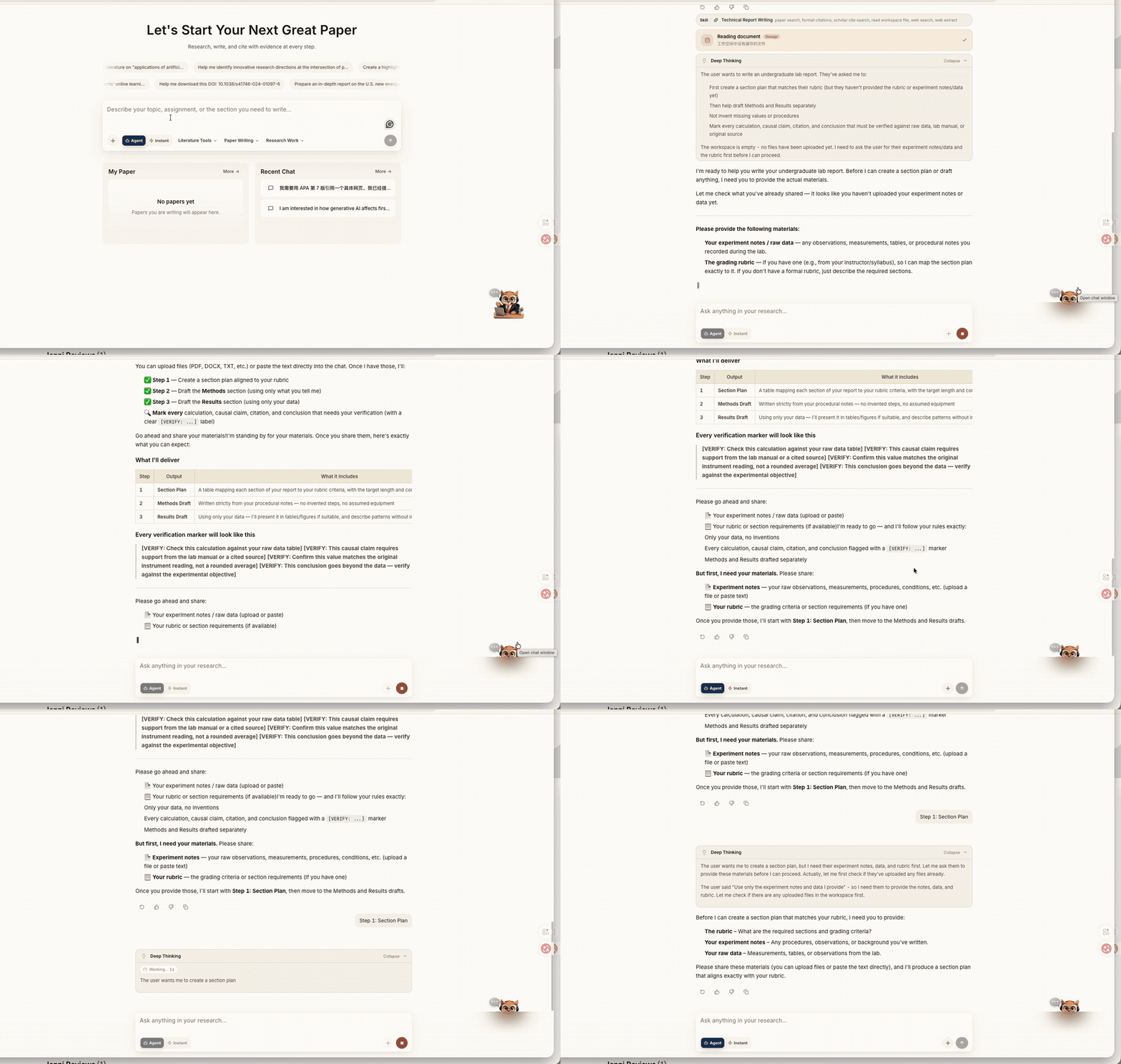
How Acade Helps Complete a Lab Report
Acade is an AI research assistant that can support academic research and writing workflows. A lab-report task can be delegated in bounded stages:
Enter the experiment topic and assignment requirements.
Organize the purpose, research question, and hypothesis.
Build a report structure from the actual experimental record.
Draft Methods, Results, and Discussion separately.
Organize data-analysis notes and descriptions of tables or figures.
Draft a conclusion grounded in the reported evidence.
Review scientific language, consistency, and section purpose.
Organize citations and references when supported by the current plan.
Compare the draft with raw data and the marking rubric.
Make the final academic decisions and revisions yourself.
Depending on the current product configuration and plan, Acade may support research design, data-analysis workflows, research-report organization, academic writing and polishing, literature search, research-library work, and citation-related tasks. Features, Credits, prices, Citation, and Knowledge Base availability can change; check the latest Acade plan and product information before relying on a specific capability.
Acade does not guarantee a grade, publication, perfect scientific accuracy, or automatic verification of all data. It must not be used to fabricate experimental results. The student or researcher remains responsible for the experiment, source data, calculations, interpretation, course compliance, citations, original contribution, and final submission.
A practical task prompt for Acade
I am writing an undergraduate lab report. Use only the experiment notes and data I
provide. First create a section plan that matches this rubric. Then help me draft
Methods and Results separately. Do not invent missing values or procedures. Mark
every calculation, causal claim, citation, and conclusion that I must verify against
the raw data, lab manual, or an original source.
Frequently Asked Questions
What is a lab report?
A lab report is a structured account of an experiment. It explains the scientific purpose, the method actually used, the observations and data collected, the interpretation of the results, and the conclusion supported by the evidence. Its purpose is not merely to repeat a procedure or show that a predicted answer was correct.
How do you write a lab report?
Review the assignment, organize the original notes and data, identify the purpose and hypothesis, describe the actual method, report results accurately, interpret them in Discussion, and write an evidence-based conclusion. Add required citations, tables, figures, calculations, and appendices, then verify the report against the rubric and raw record.
What should a lab report include?
A typical report includes a title, Introduction, Materials and Methods, Results, Discussion, Conclusion, and References. An Abstract and appendices may also be required. Some courses combine or rename sections, so the assignment prompt, lab manual, rubric, and instructor guidance take priority over a general structure.
What is the correct lab report format?
There is no single universal format. Requirements may specify headings, spacing, page numbers, citation style, table and figure conventions, appendices, and file type. Use the format assigned by your course or institution. Keep units, numbering, terminology, and visual presentation consistent throughout the report.
How do I start a lab report?
Start the writing process by checking the rubric and organizing the experimental record. For the visible report, the Title identifies the experiment and the Introduction normally begins with relevant scientific context before narrowing to the objective and hypothesis. Avoid a broad opening that does not help explain the specific experiment.
How do I write a lab report introduction?
Move from relevant scientific context and principles to the experimental problem, objective, and hypothesis. Include only background needed to understand the investigation and cite external scientific claims as required. Do not turn a short student Introduction into an unrelated literature review or report the results before the appropriate section.
How do I write the Methods section?
Describe what was actually done in a chronological or logical order. Include relevant materials, settings, variables, controls, replication, measurement procedures, and data-processing methods. Record meaningful changes from the planned procedure. Do not copy the lab manual verbatim, invent missing steps, or include results in Methods.
What is the difference between Results and Discussion?
Results reports observations, measurements, calculations, patterns, tables, and figures. Discussion explains what those results mean, evaluates the hypothesis, connects the pattern to scientific concepts, and addresses uncertainty and limitations. If the course combines them, keep evidence and interpretation clearly distinguishable within each paragraph.
How do I write a conclusion for a lab report?
Return to the objective, state the main result, explain whether the evidence supports the hypothesis, give the most defensible interpretation, and mention a major limitation when relevant. Do not introduce new data. Avoid writing only that the experiment was “successful”; explain what can be concluded from the evidence.
Does a lab report need an abstract?
Only if the assignment, course, department, or publication requires one. When needed, write it after the main report and summarize the purpose, method, key result, and conclusion. Confirm that all values and claims match the Results. An Abstract and a Conclusion have different functions and should not be identical.
What tense should a lab report use?
Methods and observed Results commonly use past tense because they describe completed work. Established scientific principles may use present tense. Discussion may use both depending on whether it refers to the current experiment or general knowledge. Follow the assigned disciplinary guidance rather than applying one absolute tense rule.
Can I use first person in a lab report?
It depends on the course and discipline. Some instructors allow or prefer clear first-person language, while others request passive or impersonal wording. Follow the actual instructions. Accuracy and clarity are more important than replacing every “we” with awkward passive language that obscures responsibility for an action.
Does a lab report need citations?
Often, yes. Cite scientific theory, background information, published values, standard methods, external datasets, figures, images, definitions, and prior research when required. Ensure that in-text citations match the reference list and use the assigned style consistently. Experimental observations from your own authorized record are documented differently from published sources.
How long should a lab report be?
Follow the assigned word or page limit. Without a fixed limit, include enough detail to explain the purpose, method, evidence, interpretation, and conclusion without unnecessary repetition. A short introductory laboratory exercise and a full scientific report require different levels of detail, so no single length applies to every task.
Can AI help write a lab report?
AI can help organize notes, create a section plan, clarify language, separate Results from Discussion, check consistency, and build a revision list. It cannot conduct the experiment, supply missing data, verify every calculation, or make unsupported conclusions. Never use AI to fabricate observations, procedures, references, or results.
How do I verify an AI-assisted lab report?
Compare every method detail with the notebook and lab manual, every number with raw data or a transparent calculation, every table and figure with its source, every scientific claim with an appropriate reference, and every conclusion with the reported evidence. Check the final document against the rubric and revise it yourself.
Conclusion
Learning how to write a lab report means building a traceable connection from the experiment’s purpose and method to its data, interpretation, and conclusion. Methods records what was done, Results reports what was observed, and Discussion explains what the observations mean. The Conclusion must answer the objective without exceeding the evidence.
Keep the original notes, unexpected results, units, calculations, figures, and sources visible throughout the writing process. Verify them before submission, especially when AI has assisted with organization or wording.
Complete Your Lab Report with Acade
Tell Acade your discipline, experiment, assignment requirements, available notes and data, and constraints. Let it help organize the next report task while you retain control of the evidence, scientific judgment, and final submission.
About the author
Elena Brooks
Academic Research Content Editor at Acade
Elena Brooks is an Academic Research Content Editor at Acade. She creates practical, evidence-informed content about literature research, research design, academic writing, and the responsible use of AI in scholarly work. She works with Acade’s product team to evaluate research workflows, verify product capabilities, and translate complex academic processes into clear guidance for students and researchers.
Research smarter with Acade
One Academic Agent for literature search, research design, writing, and more.
Try Start free →No credit card required.