
How to Write a Research Question: Steps, Examples, and Checklist

Written by Elena BrooksLast updated: August 5, 202622 min read

The best way to write a research question is to identify a focused problem, define who or what you will study, clarify the key concepts or variables, and make sure the question can be answered with an appropriate research method. A strong question is clear, researchable, feasible, relevant, and narrow enough for the time and evidence available.
Use this quick formula:
What do I want to understand, describe, compare, explain, or evaluate?
Research smarter with Acade
One Academic Agent for literature search, research design, writing, and more.
Try Start free →Who or what am I studying?
In what context?
What evidence could answer the question?
Is the scope realistic?
Already have a topic? Describe it to Acade, add your audience and research goal, and ask the academic research agent to help you compare and refine possible questions.
What Is a Research Question?
A research question is the specific question a study is designed to answer with evidence. It connects the research problem to the literature search, study design, data collection, and analysis.
A research question is not the same as a topic, title, or hypothesis:
Element | Purpose | Example |
|---|---|---|
Topic | Names a general area of interest | The use of AI in higher education |
Broad question | Identifies an interest but not a workable study | How does AI affect education? |
Focused research question | Defines a researchable relationship, population, and context | How is weekly use of generative AI tutoring tools associated with academic self-efficacy among first-year engineering students at public universities? |
Hypothesis | Predicts an expected relationship or difference | Students who use generative AI tutoring tools at least three times per week will report higher academic self-efficacy scores than students who do not use them. |
The focused question is more researchable because it identifies the behavior being examined, an outcome that can be operationalized, a population, and a setting. It also uses associated with, not causes, because an observational study would not by itself establish causation.
A well-formed question does more than make a sentence sound academic. It determines what evidence is relevant and what methods could produce a defensible answer. In evidence reviews, for example, the U.S. Agency for Healthcare Research and Quality explains that key questions guide search strategies, study selection, data extraction, synthesis, and reporting. (AHRQ)
What Makes a Good Research Question?
A good research question is clear, focused, researchable, feasible, relevant, ethically appropriate, and aligned with the intended method.
Quality | What it means | Quick test |
|---|---|---|
Clear | Readers can understand the question without guessing what key terms mean. | Can you define every important term? |
Focused | The question addresses one manageable problem. | Could one realistic study answer it? |
Researchable | Evidence—not opinion alone—can be used to answer it. | What data or sources would you examine? |
Feasible | The study fits the available time, access, skills, sample, and budget. | Can you obtain the evidence ethically? |
Relevant | The answer matters to scholarship, practice, policy, or a defined community. | Who could use the answer, and how? |
Specific | The population, context, concepts, or variables are sufficiently bounded. | Does the wording show what is included? |
Ethical | The study can protect participants and meet institutional requirements. | Would review, consent, privacy, or risk controls be required? |
Method-aligned | The question can be answered by the proposed design and evidence. | Does the wording overstate what the design can show? |
Analytically useful | The answer can support interpretation rather than a trivial yes/no response. | What meaningful comparison, pattern, explanation, or theme could result? |
The FINER framework—Feasible, Interesting, Novel, Ethical, and Relevant—is a useful quality check, especially in health and clinical research. PICO or PICOT can help structure some comparative or intervention questions by specifying the population, intervention, comparator, outcome, and sometimes time. These are tools, not universal templates. A qualitative inquiry into lived experience, for example, should not be forced into an intervention-comparison structure. (PICO and FINER overview; AHRQ PICOTS guidance)
How to Write a Research Question in 7 Steps
The following process turns a broad interest into a question that can guide an actual study. The running example is hypothetical and is provided for research-methods instruction.
Step 1: Start with a broad topic
Why it matters: A broad topic gives you a direction, but it does not yet identify a problem that can be investigated.
What to do: Write the subject in plain language. Then list the part that interests you most and why it may matter.
Intermediate output:
AI tools and student learning
Common mistake: Turning the topic into a question without narrowing it: “How does AI affect students?”
Example: The topic could include tutoring, assessment, study habits, writing, confidence, access, or academic integrity. One project cannot examine all of them well.
Step 2: Identify the research problem
Why it matters: A research problem describes what is uncertain, contested, insufficiently understood, or difficult in practice.
What to do: Complete this sentence: “We know ___, but we do not yet understand ___ for ___ in ___.” Do not claim a research gap until you have checked the literature.
Intermediate output:
Students are increasingly using generative AI tools, but it is unclear whether different patterns of use are associated with differences in academic self-efficacy among first-year engineering students.
Common mistake: Treating a personal assumption as an established gap.
Example: “AI reduces learning” presupposes a result. “The relationship between AI-use patterns and academic self-efficacy is unclear” identifies something that can be investigated.
Step 3: Review the existing literature
Why it matters: A preliminary search shows how researchers define the problem, which populations have been studied, what evidence already exists, and which methods are commonly used. It also helps prevent accidental duplication.
What to do: Search major concepts and synonyms. Read recent reviews first, then inspect relevant primary studies. Record definitions, populations, measures, study designs, limitations, and unresolved disagreements.
Intermediate output: A short evidence map containing:
established findings;
conflicting results;
understudied populations or contexts;
commonly used measures;
accessible data sources;
limitations your project might address.
Common mistake: Declaring a gap because the first search returned few papers. A weak search is not evidence that no research exists.
Example: The search may show many studies on general attitudes toward AI but fewer studies separating frequency of use, purpose of use, and academic self-efficacy in introductory engineering education.
Use Acade's Academic Search and Literature Review workflows to organize this stage, or follow the guide on how to find research papers. Search results and AI-generated summaries still require verification against the original sources.
Step 4: Define the population and context
Why it matters: Results that apply to one group, institution, country, or course may not transfer to another.
What to do: Specify only the boundaries that affect the study:
population or unit of analysis;
institution, region, or setting;
subject or disciplinary context;
relevant timeframe;
essential inclusion or exclusion criteria.
Intermediate output:
First-year engineering students enrolled in introductory statistics courses at public universities during one academic term.
Common mistake: Adding details merely to make the question look precise. Every boundary should have a methodological reason.
Example: “First-year engineering students” may be justified if the transition to university and the course requirements create a distinct learning context. If institution type is irrelevant or recruitment across public universities is impossible, remove that boundary.
Step 5: Identify the concepts or variables
Why it matters: You need to know what evidence will represent the idea in your question.
What to do: For quantitative work, identify measurable variables and how they could be operationalized. For qualitative work, identify the experience, process, meaning, or perspective to explore.
Intermediate output:
Exposure or predictor: weekly use of generative AI tutoring tools;
Outcome: academic self-efficacy measured with a justified instrument;
Possible contextual variables: course format, prior academic experience, or purpose of AI use.
Common mistake: Using broad terms such as “learning,” “success,” or “impact” without defining what they mean.
Example: If “AI use” includes brainstorming, tutoring, answer generation, and proofreading, frequency alone may conceal important differences. The study may need a clearer definition or several use categories.
Step 6: Choose the appropriate question type
Why it matters: The verb in a question creates expectations about the evidence and analysis.
What to do: Match the question to your purpose:
Descriptive: What is happening, how often, or among whom?
Comparative: How do two or more groups or conditions differ?
Correlational: Are variables associated?
Exploratory: How do people experience or understand a phenomenon?
Explanatory: What processes or mechanisms may account for a pattern?
Evaluative: How well does a program, intervention, or policy meet defined criteria?
Causal: Does an intervention or exposure produce a change? Use this wording only when the design supports causal inference.
Intermediate output: A correlational question is most appropriate if the planned design measures naturally occurring AI use and self-efficacy without assigning an intervention.
Common mistake: Asking “What effect does X have on Y?” when the available data can show only an association.
Example: Replace “How does AI use improve self-efficacy?” with “What is the association between weekly AI-tool use and academic self-efficacy?” unless a defensible causal design is available.
Step 7: Write and test the final question
Why it matters: The final wording should tell you what evidence to collect and what the study can reasonably conclude.
What to do: Draft the question, test it against the quality checklist, and revise it after a preliminary literature and feasibility review.
First draft:
Does AI help engineering students learn statistics?
Revision:
Is generative AI use related to learning outcomes among first-year engineering students?
Final working question:
What is the association between weekly use of generative AI tutoring tools and academic self-efficacy scores among first-year engineering students enrolled in introductory statistics courses at public universities?
Common mistake: Treating the first polished sentence as final. A research question usually changes when the literature, data access, measures, or ethical constraints become clearer.
Why the final version is stronger: It states the relationship, exposure, outcome, population, and context; it does not claim causation; and it points toward a feasible observational design. It remains a working question until the researcher confirms access, measurement quality, sample needs, institutional requirements, and scholarly relevance.
How to Narrow Down a Research Question
Use this sequence when a question is too broad:
Broad field → topic → problem → population → context → variable or phenomenon → timeframe → final question
Example A: Education
Broad: How does AI affect students?
Narrowed: What is the association between weekly use of generative AI tutoring tools and academic self-efficacy among first-year engineering students enrolled in introductory statistics courses?
This revision identifies a form of AI use, an outcome, a population, and a course context. The association wording is compatible with observational evidence.
Example B: Public health
Broad: Why do people avoid vaccination?
Narrowed: What concerns influence influenza vaccination decisions among adults aged 65 and older receiving care in rural primary-care settings?
This revision names a vaccine, population, decision, and setting. It could support interviews or another design focused on reported concerns. It is a methodological example, not medical advice.
Narrowing does not mean adding every possible qualifier. An over-narrow question may have little scholarly value or too few eligible cases. Match the scope to the time, sample, data access, and resources you actually have.
Types of Research Questions
Type | Best used when you want to | Common wording | Hypothetical example | Possible methods | Common misuse |
|---|---|---|---|---|---|
Descriptive | Characterize a population or phenomenon | What, how common, how often | What study-support tasks do first-year students report using generative AI for? | Survey, content analysis, descriptive dataset | Presenting description as explanation |
Comparative | Examine differences between groups or conditions | How does X differ between A and B? | How do academic self-efficacy scores differ between frequent and infrequent users of AI tutoring tools? | Comparative observational study or experiment | Ignoring confounding or baseline differences |
Correlational | Examine an association between variables | What is the relationship or association? | What is the association between weekly AI tutoring use and self-efficacy scores? | Survey, cohort, secondary-data analysis | Calling an association an effect |
Exploratory | Understand experiences, meanings, or emerging issues | How do, in what ways, what experiences? | How do first-year students describe integrating AI tools into their study routines? | Interviews, focus groups, observation | Forcing responses into predetermined variables |
Explanatory | Investigate why or through what process a pattern occurs | How or through what mechanisms? | How do feedback practices shape students' decisions to rely on AI tutoring tools? | Case study, interviews, mixed methods | Claiming a complete explanation from limited evidence |
Evaluative | Assess a program or intervention against criteria | To what extent, how well? | To what extent does an AI-literacy workshop meet its stated learning objectives? | Program evaluation, mixed methods | Evaluating without predefined criteria |
Causal | Estimate whether an intervention produces a change | What is the effect of X on Y? | What is the effect of a structured AI-literacy intervention on source-evaluation performance? | Appropriately designed randomized or quasi-experimental study | Using causal language for cross-sectional data |
Qualitative and quantitative are not simply question “types.” They refer more broadly to forms of evidence, research logic, and methods. A descriptive question, for example, may be addressed with numerical survey data or qualitative descriptions depending on what the researcher means by “describe.”
Qualitative vs. Quantitative Research Questions
Dimension | Qualitative | Quantitative |
|---|---|---|
Main purpose | Explore meanings, experiences, processes, or perspectives | Measure variables, estimate patterns, or test relationships and differences |
Typical wording | How, in what ways, what experiences | What proportion, what difference, what association, what effect |
Typical data | Interviews, observations, documents, images, or field notes | Numerical measures, counts, scores, or structured records |
Scope | Contextual, interpretive, and often exploratory | Defined variables, population, comparison, and analysis plan |
Expected output | Themes, interpretations, mechanisms, or conceptual accounts | Estimates, comparisons, models, or statistical inferences |
Using the same topic:
Qualitative question: How do first-year university students describe the ways generative AI tools influence their study habits?
Quantitative question: What is the association between weekly generative AI use and academic self-efficacy scores among first-year university students?
The wording must match the evidence and design. A question beginning with “why” is not automatically qualitative. Likewise, a numerical analysis does not automatically support a causal claim. The CDC notes that analytic studies should be designed around the right question and that hypotheses should generally be clarified before a study is built to test them. (CDC Field Epidemiology Manual)
Research Question Examples by Discipline
All examples below are hypothetical and intended for methods instruction.
Discipline | Too broad | Revised research question | Type | Why it is stronger | Possible method |
|---|---|---|---|---|---|
Education | Does online learning work? | How do course-completion rates differ between synchronous and asynchronous sections of the same introductory course at one community college? | Comparative | Defines formats, outcome, course, and setting | Retrospective cohort with careful adjustment for group differences |
Psychology | Does social media harm students? | What is the association between nighttime social-media use and self-reported sleep quality among undergraduate students living on campus? | Correlational | Replaces “harm” with measurable concepts and a defined population | Cross-sectional survey; no causal claim |
Public health | Why do people avoid vaccination? | What concerns shape influenza vaccination decisions among adults aged 65 and older in rural primary-care settings? | Exploratory | Defines the decision, population, and setting | Semi-structured interviews |
Engineering | Are recycled materials good? | How does replacing 10%, 20%, or 30% of virgin aggregate with recycled concrete aggregate affect compressive strength after 28 days under a specified laboratory protocol? | Comparative | Defines material proportions, outcome, time, and conditions | Controlled laboratory experiment |
Business | Does remote work improve productivity? | How do monthly resolved-ticket counts differ between hybrid and fully remote customer-support teams within the same company over one year? | Comparative | Defines work arrangements, outcome, organization, and timeframe | Longitudinal organizational-data analysis with confounder review |
Social science | How does housing affect communities? | How do long-term renters describe the effects of neighborhood redevelopment on social ties in one metropolitan district? | Exploratory | Identifies perspective, phenomenon, and context | Interviews plus thematic analysis |
The “possible method” column is not a prescription. The final design must reflect the literature, available evidence, disciplinary norms, ethics review, and qualified methodological advice.
Research Question vs. Hypothesis
A research question states what the study aims to answer. A hypothesis makes a testable prediction about an expected relationship or difference.
Research question: Is weekly use of generative AI tutoring tools associated with academic self-efficacy among first-year university students?
Hypothesis: First-year university students who use generative AI tutoring tools at least three times per week will report higher academic self-efficacy scores than students who do not use them.
Not every study needs a formal hypothesis. Exploratory and many qualitative studies begin with questions rather than predictive hypotheses. If your design requires one, continue with the guide on how to write a research hypothesis.
How Many Research Questions Should a Study Have?
There is no universal correct number of research questions. The right number depends on the project scope, degree or course requirements, available evidence, design, time, and resources.
A small course project often works best with one central question. A larger thesis or mixed-methods study may use one main question and several connected subquestions. The controlling rule is practical: every question should have a clear role in the design and should be answered in the results and discussion.
Before adding a question, ask:
Does it help answer the central problem?
Does it require different participants, data, or methods?
Can the project collect and analyze that evidence?
Will the final paper actually report an answer?
If a subquestion creates a separate study, it probably does not belong in the same project.
How to Write a Research Question for a Literature Review
A literature-review question focuses on existing evidence rather than new primary data. It should define the phenomenon or intervention, relevant population or context, and the boundaries that will guide searching and study selection.
Broad topic: AI-supported learning in higher education
Focused review question: What effects of generative AI-supported learning on university students' academic performance have been reported in peer-reviewed empirical studies published from 2022 through 2026?
This wording sets a population, outcome area, evidence type, and publication period. Those choices must be justified rather than selected only for convenience. Systematic, scoping, and narrative reviews serve different purposes and may require different question frameworks and protocols. AHRQ emphasizes that clear review questions shape search strategies, eligibility criteria, data extraction, and synthesis. (AHRQ)
10 Common Research Question Mistakes—and How to Fix Them
Mistake | Weak question | Diagnosis | Better version | Why it is better |
|---|---|---|---|---|
Too broad | How does technology affect society? | No defined technology, outcome, population, or context | How do older adults in rural communities describe barriers to using telehealth portals? | Defines technology, population, setting, and phenomenon |
Trivial yes/no structure | Do students use AI? | Produces little analysis | What academic tasks do first-year students report using generative AI for, and how frequently? | Supports descriptive analysis |
Multiple projects in one sentence | How does AI affect grades, wellbeing, employment, teaching, and university policy? | Combines unrelated outcomes and units | What is the association between weekly AI tutoring use and statistics-course performance among first-year students? | Creates one answerable focus |
Vague concepts | Does AI improve learning? | “AI,” “improve,” and “learning” are undefined | What is the association between weekly use of AI practice feedback and scores on a validated statistics-concept inventory? | Identifies exposure and outcome |
Assumes the conclusion | Why does remote work make employees less productive? | Presupposes harm | How do task-completion rates differ between hybrid and fully remote teams? | Allows multiple outcomes |
Data mismatch | How do all U.S. teenagers experience algorithmic recommendations? | Likely inaccessible population and evidence | How do students aged 16–18 at two participating schools describe algorithmic recommendations on short-video platforms? | Matches a plausible sample and qualitative design |
Method mismatch | What is the national prevalence of burnout? based on ten interviews | Interviews cannot estimate national prevalence | How do ten resident physicians at one hospital describe workplace factors related to burnout? | Aligns the claim with qualitative evidence |
Unsupported causal wording | How does social-media use cause poor sleep? | A cross-sectional survey cannot establish causation | What is the association between nighttime social-media use and self-reported sleep quality? | States what the design can estimate |
Undefined population or setting | What influences vaccination decisions? | Applicability is unclear | What concerns influence influenza vaccination decisions among adults aged 65 and older in rural primary care? | Defines decision, population, and context |
Ethically impractical | What happens when essential treatment is withheld from patients? | May expose participants to unacceptable harm | What do existing clinical records show about outcomes associated with documented treatment delays, subject to ethics and privacy approval? | Reframes the question around potentially usable evidence without proposing harm |
Research Question Quality Checklist
Copy this checklist and answer each item before finalizing your question:
[ ] Is the question understandable without extra explanation?
[ ] Does it address one focused problem?
[ ] Can it be answered with evidence rather than opinion alone?
[ ] Is the population, unit of analysis, or context defined where necessary?
[ ] Can the key concepts, variables, or phenomena be operationalized or explored?
[ ] Does the wording match the proposed research method?
[ ] Is it feasible with the available time, access, skills, sample, and budget?
[ ] Does it avoid assuming the conclusion?
[ ] Does it avoid causal language unless the design supports causal inference?
[ ] Can the work meet applicable ethics, consent, privacy, and institutional requirements?
[ ] Does the answer have scholarly or practical value?
[ ] Can the final study actually answer every part of the question?
If several answers are “no” or “not yet,” revise the question before building the full study plan.
Use Acade to Develop and Refine Your Research Question
Acade is an AI-powered academic research workspace designed to support connected research tasks. For this workflow, you can give Acade a broad topic, define your discipline and constraints, compare alternative question types, refine the scope, and continue into literature search and research design.
Acade is useful for undergraduate and graduate students, doctoral researchers, early-career researchers, and professionals planning a research project. It can help organize the reasoning process, but it does not replace subject expertise, supervision, ethics review, source verification, or the researcher's final judgment.
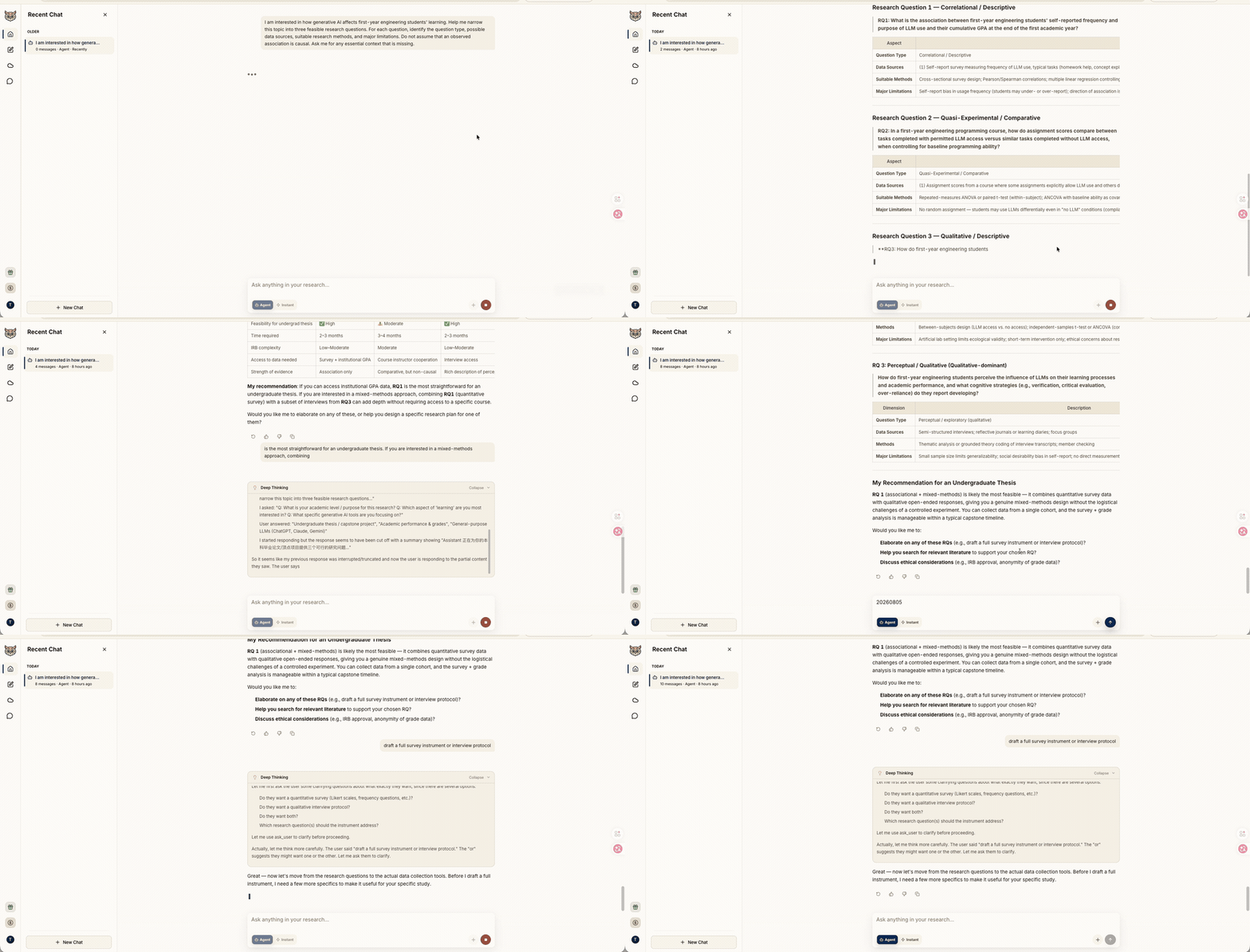
A practical Acade workflow
Describe the broad topic. State the subject and what interests you.
Add context. Include the discipline, target population, setting, timeframe, assignment level, and practical constraints.
Ask for alternatives. Request several question formulations with different purposes, such as descriptive, comparative, correlational, or exploratory.
Examine the literature. Use academic search and literature-review tools to check terminology, prior findings, disagreements, and possible evidence gaps.
Compare feasibility and method fit. Review what data each question requires, what design could answer it, and what limitations remain.
Revise the wording yourself. Choose a working question and adjust it to reflect your actual access, expertise, institutional rules, and scholarly aim.
Plan the next stage. Continue to research design and, where appropriate, hypothesis development.
Prompt to use in Acade
I am interested in how generative AI affects first-year engineering students' learning. Help me narrow this topic into three feasible research questions. For each question, identify the question type, possible data sources, suitable research methods, and major limitations. Do not assume that an observed association is causal. Ask me for any essential context that is missing.
What you should expect to review
For each proposed question, check:
whether the key concepts are defined;
whether the population and context match your project;
whether the data sources are genuinely accessible;
whether the suggested method can answer the wording used;
whether causal claims exceed the design;
whether the literature supports the claimed gap;
whether ethics, privacy, consent, or institutional review applies.
Acade's suggestions are working materials, not scholarly approval. AI-generated references, summaries, definitions, and methodological suggestions can be incomplete or wrong. Open and verify original sources, consult a qualified supervisor or methods specialist, and retain responsibility for the final question and study.
Frequently Asked Questions
What is the best way to write a research question?
Start with a real research problem, review enough literature to understand what is known, define the population or context, identify the concepts or variables, choose a question type that matches your objective, and test the wording for clarity, feasibility, ethics, relevance, and method fit.
How do I formulate a research question from a topic?
Move from the topic to a specific uncertainty. Ask what is not yet understood, for whom, in what context, and what evidence could answer it. Then narrow the question until one realistic study can address it.
How should I phrase a research question?
Use neutral, precise language. Choose verbs that match the purpose: “describe” for characterization, “compare” for group differences, “associated with” for relationships, and “explore” for experiences or meanings. Avoid “effect” or “cause” unless the design supports causal inference.
What are the characteristics of a good research question?
A good question is clear, focused, researchable, feasible, relevant, ethically appropriate, and aligned with the intended evidence and method. It should support meaningful analysis and avoid assuming its own answer.
Can a research question be answered yes or no?
It can be grammatically possible, but a simple yes/no answer often produces limited analysis. In most academic projects, wording that asks about patterns, differences, associations, experiences, or mechanisms leads to a more informative study.
What is the difference between a research question and a hypothesis?
A research question asks what the study will investigate. A hypothesis predicts an expected relationship or difference. Not every research question requires a hypothesis, particularly in exploratory and qualitative studies.
How many research questions should I have?
Use only as many as the study can answer coherently. A small project may have one main question; a larger thesis may include connected subquestions. Course, program, and supervisory requirements take precedence over general advice.
How do I know whether my question is too broad?
It is probably too broad if you cannot identify the evidence, population, context, concepts, or method required to answer it—or if answering it would require several separate studies.
Can Acade write my final research question for me?
Acade can help generate alternatives, expose missing context, compare question types, and support literature and design planning. You must verify the evidence, make the final methodological and ethical decisions, and ensure the question meets your institution's requirements.
Turn Your Topic into a Focused Research Question
Tell Acade what you want to study, who or what your research concerns, what evidence you can access, and what constraints you face. Then ask it to compare possible questions, identify method mismatches, and help you plan the next research step.
About the author
Elena Brooks
Academic Research Content Editor at Acade
Elena Brooks is an Academic Research Content Editor at Acade. She creates practical, evidence-informed content about literature research, research design, academic writing, and the responsible use of AI in scholarly work. She works with Acade’s product team to evaluate research workflows, verify product capabilities, and translate complex academic processes into clear guidance for students and researchers.
Research smarter with Acade
One Academic Agent for literature search, research design, writing, and more.
Try Start free →No credit card required.