
Is It Okay to Use AI for Research?
Acade Team · August 4, 2026
Is It Okay to Use AI for Research?
Quick answer
Yes, it can be okay to use AI for research—especially to plan a literature search, discover papers, organize notes, compare methods, and improve language—if your instructor, institution, funder, ethics board, and target publisher permit that use. AI should support, not replace, your reading, source verification, interpretation, original contribution, or accountability. Never upload protected, confidential, unpublished, or identifiable clinical information unless the tool and your institution explicitly authorize it.
For students, “allowed” may depend on the course or assignment. USC’s academic-integrity guidance, for example, says presenting AI-created material as the student’s own can constitute plagiarism, while its broader policy also makes clear that school, department, and course requirements still apply. Researchers and clinicians face additional rules concerning privacy, research ethics, peer-review confidentiality, and publication disclosure. There is no universal yes-or-no rule that overrides those local requirements.
Acade is designed for the permitted, supervised side of this line: it is an AI-powered academic research workspace and research super agent for students, researchers, healthcare professionals, and other knowledge professionals. You can describe a research topic, goal, and constraints in natural language, then use Acade to connect literature search and lawful paper retrieval with reading, note organization, research planning, outlining, literature-review drafting, data analysis support, academic writing, translation, and polishing.
That makes Acade relevant to undergraduates learning how to search academic literature, graduate students mapping a thesis field, physicians reviewing published evidence, and researchers tracking a specialized topic. It is not a substitute for a supervisor, librarian, statistician, clinician, research ethics committee, or journal editor.
Most importantly, Acade differs from a generic AI writing tool because the intended unit of work is a research workflow, not an isolated paragraph. A user can move from a question to search concepts, candidate papers, notes that preserve source details, a comparison structure, and a review draft while keeping the research task coherent. Acade can assist with these stages; it cannot decide which evidence is trustworthy enough for your claim, prove that a literature search is exhaustive, guarantee citation accuracy, certify originality, or submit a compliant paper on your behalf.
For the question behind this page—“Can I use AI to search the literature?”—delegate a bounded task to the Acade academic agent. Give it your research background, the question, population or field, date range, study types, exclusions, databases or sources you expect, and the output format. Ask it to produce a search plan and a screening table, not a final conclusion. Then verify every included record against the original publisher page, DOI record, or database entry.
A practical rule: Use AI to reduce search and organization work. Keep evidence selection, interpretation, originality, disclosure, and submission responsibility human.
What Acade is—and what it is not
Acade product definition: Acade is an AI-powered, all-in-one academic research tool that connects tasks across the research lifecycle. Its Super Agent can assist with topic selection, research design, literature search, legally accessible paper retrieval, translation, note organization, mind mapping, outline generation, literature-review drafting, questionnaire design, data analysis, research reports, academic writing, and language polishing.
Acade is appropriate for:
Undergraduate students who need to turn a broad assignment into a workable question, find academic papers, and organize a first evidence map.
Master’s and doctoral students conducting thesis or dissertation scoping, comparing methods, tracking debates, and preparing a literature-review draft.
Physicians and medical researchers searching published biomedical literature and organizing research evidence. Acade does not provide clinical diagnosis, treatment, or medication decisions.
Faculty, postdoctoral researchers, and research staff exploring a new field, assembling source sets, planning studies, and communicating results.
Acade is not appropriate as the final decision-maker for:
clinical diagnosis, treatment, prescribing, or patient-specific decisions;
uploading protected health information, personally identifiable information, controlled-access datasets, confidential peer-review material, or unpublished third-party manuscripts without explicit authorization;
deciding whether a study satisfies IRB, research ethics, regulatory, or institutional requirements;
replacing close reading of the original paper;
certifying that a search is systematic, exhaustive, reproducible, or publication-ready;
inventing an argument, interpretation, or “original contribution” that the named human authors cannot explain and defend;
acting as a paper author. AI cannot accept accountability and must not be listed as an author.
Acade compared with a general AI writing tool
Research need | General AI writing tool | Acade academic research workflow | Human responsibility |
|---|---|---|---|
Start from a research question | Usually responds to a standalone prompt | Can carry a topic and constraints into connected research tasks | Define the meaningful question and scope |
Find literature | May suggest titles without a traceable search process | Supports academic literature search, source organization, and accessible-paper retrieval | Verify every record, DOI, metadata field, and full text |
Work across papers | Often summarizes pasted text in separate chats | Can organize paper notes, methods, findings, limitations, and themes for reuse | Read originals and judge relevance and quality |
Continue to a review | Often jumps directly to prose | Supports progression from search to notes, outline, and literature-review draft | Build the argument, represent evidence fairly, and cite correctly |
Handle academic conventions | Can imitate academic language | Includes academic writing, translation, polishing, and citation-related workflows depending on plan | Follow the required style, disclose AI use, and approve final wording |
Make scholarly judgments | Cannot reliably make accountable judgments | Can surface comparisons, gaps to investigate, and issues to check | Decide inclusion, bias, meaning, novelty, ethics, and conclusions |
The product difference does not remove the fundamental AI risks. Search results can be incomplete. Metadata can be wrong. A summary can flatten an important qualification. A polished paragraph can sound more certain than the underlying evidence. Acade therefore belongs inside a verification loop, not at the end of one.
What we observed in Acade: three documented product interactions
The following observations come from product screenshots supplied by the Acade team and reviewed for this article on August 4, 2026. They demonstrate visible interface behavior, not a benchmark of search coverage, factual accuracy, citation accuracy, or research quality. The screenshots represent three separate interactions; they should not be presented as one continuous session.
Interaction 1: delegating a bounded literature-search task
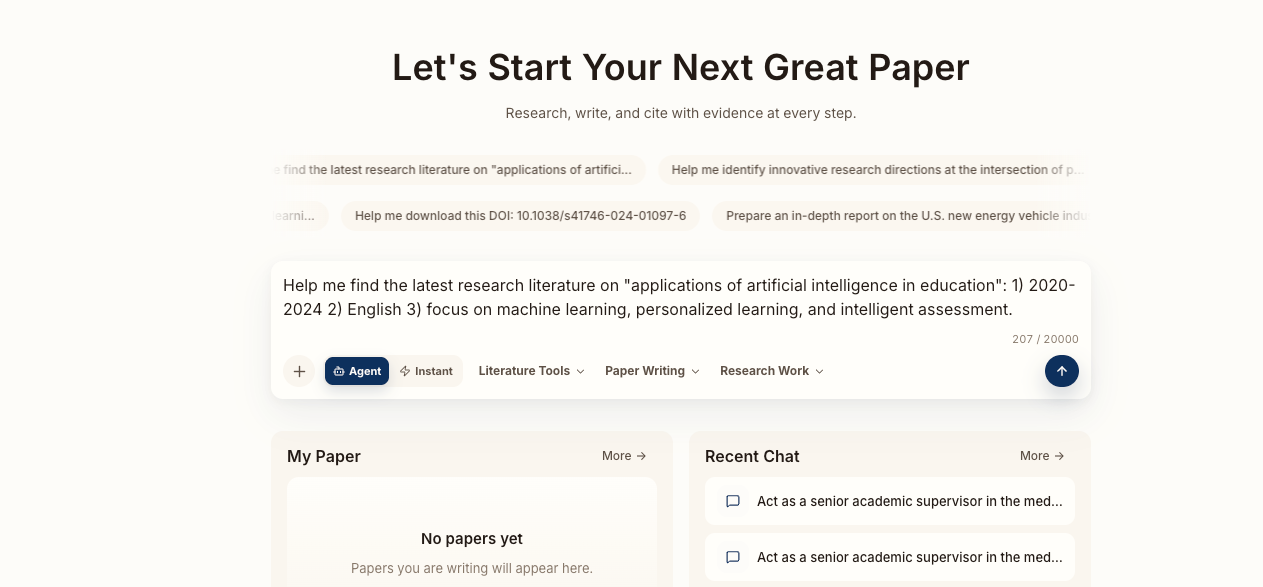
In the first screenshot, a user selected Agent mode and entered this prompt:
Help me find the latest research literature on “applications of artificial intelligence in education”: 1) 2020–2024 2) English 3) focus on machine learning, personalized learning, and intelligent assessment.
This is a stronger literature-search request than “find papers about AI” because it specifies the topic, publication years, language, and three focus areas. The visible screenshot documents the task being delegated; it does not show the returned papers. No claim about result count, database coverage, relevance, or citation correctness can be drawn from that image alone.
Interaction 2: asking for missing research parameters
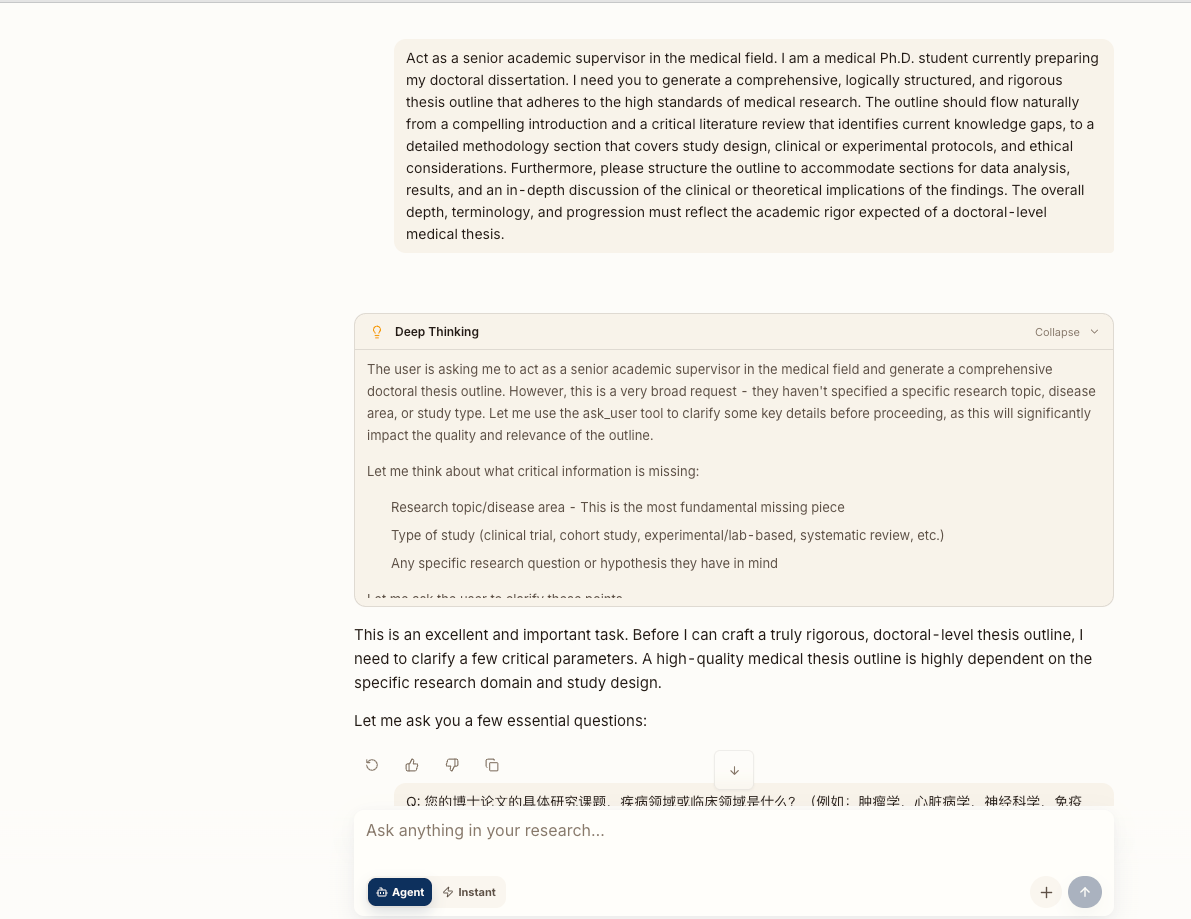
In a separate medical-research interaction, the user asked Acade to act as a senior academic supervisor and generate a rigorous doctoral thesis outline but did not provide a disease area, study design, or research question. The screenshot shows Acade identifying those missing parameters and asking for clarification before producing the outline.
That behavior is useful because research design depends on context. It is not equivalent to academic supervision, and the user must still obtain supervisor, methodological, clinical, and ethics input. It also does not prove that every Acade response will ask the right clarifying questions.
Interaction 3: producing a structured review outline
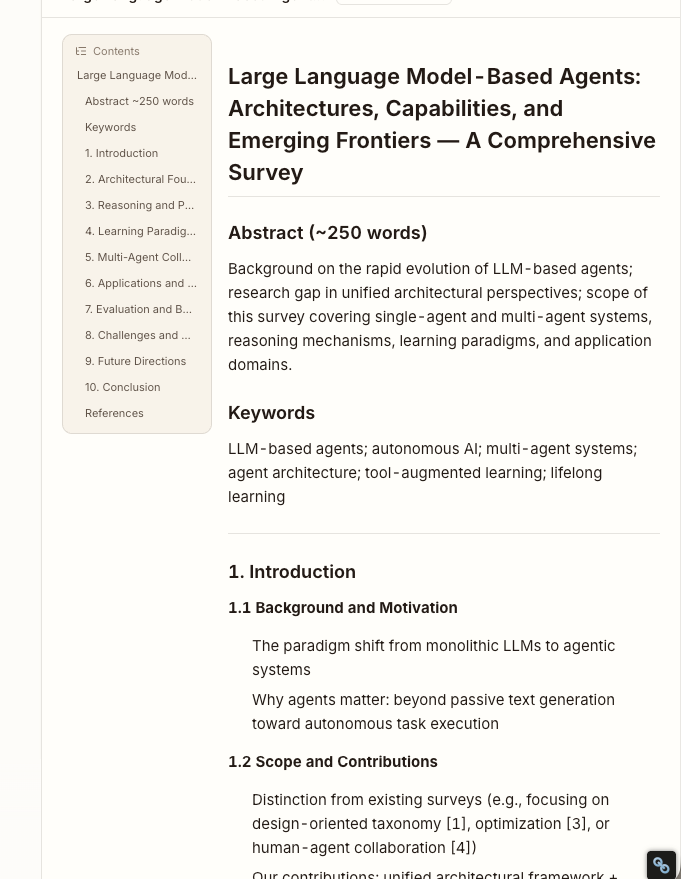
A third screenshot shows an Acade-generated outline titled “Large Language Model-Based Agents: Architectures, Capabilities, and Emerging Frontiers — A Comprehensive Survey.” The visible result includes an abstract target, keywords, numbered sections, subsections, future directions, a conclusion, and references. Some outline statements display numbered citation markers.
The screenshot supports a narrow product claim: Acade can generate a detailed academic outline. It does not establish that the cited sources are correct, that the survey is comprehensive, or that the proposed contribution is original. A researcher must open and verify every referenced source, refine the scope, and build the final argument.
A safer output request for literature search
To make the first interaction easier to audit, add explicit output and verification instructions:
Return search concepts and synonyms, then a candidate-paper table with title, authors, year, study design, DOI or source link, and a one-sentence relevance note. Put uncertain records in a separate list. Do not invent missing metadata, and mark every item that requires checking against the original publisher or database record.
The resulting table should be treated as a screening workspace, not a finished evidence base. The researcher still chooses the review type, validates searches in appropriate databases, records the final strategy, reads every included paper, assesses quality, and writes the synthesis.
How to use Acade for a responsible literature search
1. Check permission before opening the tool
For coursework, read the syllabus and assignment instructions, then ask the instructor if the rule is unclear. For a thesis or dissertation, check graduate-school and supervisor expectations. For a manuscript, read the target journal’s current AI policy. For funded, clinical, or human-subjects research, also consult the applicable sponsor, IRB, privacy, and institutional information-security rules.
Do this before uploading anything. An institution may allow AI for brainstorming but prohibit generated prose, undisclosed assistance, or use with nonpublic data.
2. Define a searchable question
Tell the Acade research agent who you are, what decision the review supports, and what is in or out. Depending on the discipline, structure the question with PICO, SPIDER, PCC, or another accepted framework. Add population, intervention or exposure, comparator, outcomes, context, years, languages, geography, and preferred study designs.
A strong prompt asks Acade to expose assumptions. For example: “List ambiguous terms and ask me to resolve them before searching.” This prevents a broad topic from silently becoming a narrow search.
3. Generate concepts, synonyms, and a search plan
Ask for concept groups, spelling variants, abbreviations, controlled-vocabulary candidates, and exclusion risks. Treat these as a draft. A database’s subject headings and syntax must be checked in that database. For a systematic review or a high-stakes clinical search, involve an information specialist or medical librarian.
This is where the SEO entry task—find research papers with AI—becomes agentic value: the academic agent can translate your intent into smaller subtasks, such as query planning, paper discovery, relevance triage, accessible-PDF location, and a source-verification queue.
4. Search, screen, and preserve traceability
Use Acade to identify candidate literature and organize it by relevance, method, year, source, or likely use. When a lawful open PDF or authorized full-text link is available, Acade can help locate and save it for reading. A paywall is not permission to bypass access controls; use your university library, the publisher, an authorized database, or a legal open-access copy.
For every candidate, preserve the title, author list, publication year, journal or repository, DOI or stable URL, and the date accessed when relevant. Separate “found” from “included.” A paper is not evidence for your claim merely because it appeared in an AI search result.
5. Read originals and preserve source details in your notes
Use Acade’s note-organization capability to group findings by theme, theory, method, population, agreement, contradiction, and limitation. Keep each note tied to its source and, when possible, page, table, figure, or section.
Ask questions such as: “What would make these studies non-comparable?” and “Which conclusion depends on a surrogate outcome?” Then answer those questions by examining the original text. Never cite an AI summary as if it were the underlying study.
6. Build a synthesis without outsourcing the argument
After selecting the source set, ask Acade for a comparison matrix and an outline. It may help identify recurring findings, disagreements, methodological differences, and possible gaps to investigate. It may also draft a literature-review section based on the sources you select.
The researcher must decide what the evidence means. A valid synthesis weighs design quality, sample, setting, measurement, confounding, bias, uncertainty, and applicability. It does not count positive and negative papers or repeat the most fluent summary.
7. Verify, disclose, and document
Before submission, open every cited source. Check authors, title, date, journal, DOI, quotations, numbers, tables, and the claim supported. Confirm that the citation style matches the course or journal. Review the entire output for unsupported inference, plagiarism, distorted paraphrase, and missing counterevidence.
Document how AI was used. Disclosure requirements vary, so use the exact location and wording required by your institution or publisher. Keep a lightweight research log with the tool name, access date, purpose, major prompts or task descriptions, human verification performed, and any output incorporated.
Acade and the human researcher: the responsibility boundary
Acade can assist with | The human researcher must own |
|---|---|
Turning a topic into candidate search concepts | The research question’s intellectual and practical significance |
Finding and organizing candidate papers | Database choice, final search strategy, and claims of completeness |
Retrieving legally accessible papers | Lawful access and respect for license or copyright restrictions |
Summarizing methods, findings, and limitations | Close reading and accurate interpretation of the original source |
Comparing sources and suggesting a structure | Critical appraisal, bias assessment, synthesis, and original contribution |
Drafting or polishing text when permitted | Authorship, originality, disclosure, citations, and final wording |
Supporting data analysis and explanation | Method choice, assumption checking, validation, and conclusions |
Flagging questions or possible research gaps | Proving novelty through current literature and disciplinary judgment |
The boundary is especially strict in medicine. Acade may help a physician search and organize published literature, but it does not replace clinical guidelines, multidisciplinary judgment, patient context, diagnosis, treatment, prescribing, or regulatory obligations.
What authoritative policies say
Policies differ, but several principles recur.
Course and institutional permission comes first. USC states that material created by generative AI and presented as a student’s own can be treated as plagiarism. Its 2026 general policy also says use of an approved enterprise tool does not remove the obligation to comply with school, department, research-integrity, and course rules. See USC Office of Academic Integrity guidance and the USC Generative AI General Policy.
AI is not an author. The NIH’s guidance for trainees says natural-language AI programs do not meet NIH authorship criteria, and the ICMJE recommendations state that authors should not list or cite AI-assisted technologies as authors. Human authors remain accountable. See NIH guidance on the use of AI and the ICMJE Recommendations.
Disclosure may be required. NIH guidance says use of natural-language programs for writing, editing, literature review, or data interpretation should be fully disclosed. Elsevier requires an AI declaration for AI-assisted manuscript preparation and keeps responsibility for originality, authorship, and rights with the authors. Always check the specific journal because requirements can change. See Elsevier’s policy on generative AI in writing.
Confidential material may be off-limits. NIH prohibits its scientific peer reviewers from uploading grant applications, proposals, critiques, or original concepts to online generative AI tools because doing so violates peer-review confidentiality. NIH also warns that inputs to external AI providers can unintentionally disclose research data. See NIH Notice NOT-OD-23-149 and NIH AI in Research policy considerations.
These policies answer the headline question more precisely: AI use is acceptable only within the rules governing the particular task, data, course, institution, funder, and publication.
Acade’s free plan: useful for evaluation, with real limits
As checked against the supplied Acade plan table and the Acade application on August 4, 2026, the Free plan is presented as requiring no payment and includes 1,000 Credits, unlimited writing, the Lite model, Deep Research, Super Agent, AI-assisted writing, and 100 MB of cloud storage. The comparison marks Citation tools, Knowledge base, and the ability to purchase additional Credit packs as unavailable on Free.
That makes the Free plan suitable for testing a bounded task: clarifying a question, drafting search concepts, trying a small literature-search request, or organizing a modest set of notes. It is not a promise that a long review, deep research task, or repeated literature workflow will fit within the available allowance.
Credits are usage-based, so the amount consumed can vary with the task and model. Prices, included Credits, expiration rules, storage, models, queues, and feature access can change. Check the latest plan comparison and live usage information inside Acade before relying on a limit. Do not assume Citation tools or Knowledge base access unless your current plan explicitly includes them.
When using AI for research is not okay
Do not use Acade—or another AI system—when the relevant rule prohibits it. Stop when the assignment requires unaided work, the journal disallows the intended use, the material is confidential, or you lack authorization to upload the data.
It is also not okay to:
submit AI-generated analysis you do not understand or cannot defend;
cite papers you have not verified;
fabricate, alter, or misrepresent research data, images, methods, or results;
use AI output to conceal plagiarism or evade attribution;
claim an AI-assisted search was systematic or exhaustive without a reproducible protocol and appropriate validation;
upload patient data, controlled-access data, reviewer materials, proprietary documents, or identifiable participant information without explicit authorization and suitable safeguards;
list Acade or any AI system as an author.
If your project involves a clinical decision, high-stakes evidence review, systematic review, meta-analysis, regulatory submission, or novel statistical analysis, add qualified human review. An academic agent can accelerate the work; it cannot confer validity.
Frequently asked questions
Can I use AI to find sources for a research paper?
Yes, if your course or institution permits it. Use AI to develop keywords and find candidate sources, then open and verify each source in the original journal, database, DOI record, or repository before citing it.
Is using AI for a literature review plagiarism?
Not automatically. It can become misconduct if you submit generated text or ideas as entirely your own, fail to disclose required assistance, use unattributed language, or violate an assignment policy. Follow the strictest applicable course, institutional, and publisher rule.
Can Acade guarantee that a citation is correct?
No. Acade can support literature search and citation-related workflows when the user’s current plan includes them, but it cannot guarantee that a reference is real, complete, correctly formatted, or appropriate for a claim. The researcher must verify it against the original source.
Can AI perform a systematic literature review?
AI can assist with question refinement, query development, screening organization, extraction structure, and drafting. It cannot independently certify that a review is exhaustive, reproducible, unbiased, protocol-compliant, or ready for publication. Human reviewers remain responsible for the protocol, databases, deduplication, screening decisions, risk-of-bias assessment, synthesis, and reporting.
Is it okay for doctors to use AI for medical research?
It can be appropriate for searching public literature and organizing evidence within institutional and legal rules. AI must not receive unauthorized patient information, replace clinical judgment, or make patient-specific diagnosis, treatment, or medication decisions.
Do I need to disclose Acade in my paper?
Possibly. Disclosure depends on how you used it and the rules of your institution, funder, and target journal. When disclosure is required, describe the tool, purpose, and extent of assistance in the specified section. Never name an AI system as an author.
Can I upload an unpublished manuscript or peer-review file to Acade?
Only if you own or are authorized to share it and all applicable confidentiality, publisher, funder, and institutional rules explicitly allow that tool and data use. For confidential peer review, the safe default is no. NIH explicitly prohibits its reviewers from uploading NIH application materials to online generative AI tools.
What is the safest first task to give an AI research agent?
Ask for a search plan rather than a conclusion: provide a public research question and request concept groups, synonyms, inclusion and exclusion criteria, candidate databases, and a verification checklist. This creates useful structure while keeping scholarly judgment with you.
The responsible next step
The best answer to “is it okay to use AI for research?” is not unconditional permission. It is a workflow: check the rules, protect the data, define a bounded task, keep sources traceable, verify the originals, make the scholarly judgments yourself, and disclose assistance where required.
Acade can help connect the next steps—literature search, lawful paper retrieval, reading notes, comparison, outlining, and review drafting—without changing who is accountable. The final source checks, interpretations, original contribution, and submission remain yours.
Tell Acade your research background, goal, and constraints, then ask it to work with you on the next task: Open Acade and delegate your literature-search task.