
Is It Okay to Use AI for Research?
Acade Team · 4 Ogos 2026
Is It Okay to Use AI for Research?
Quick answer
It can be okay to use AI for research when the relevant instructor, university, employer, funder, ethics board, data owner, and publisher permit the specific use. Permission is task-specific. Using AI to brainstorm search terms may be allowed while using it to write an assessed argument, process confidential data, or review an unpublished manuscript may be restricted or prohibited.
AI does not become an author, supervisor, clinician, or accountable researcher. The human researcher remains responsible for source verification, interpretation, originality, privacy, disclosure, and submission.
This page answers the policy question. For a general database-search method, see How to Find Research Papers. For a product-specific paper-discovery workflow, see How to Use Acade to Find Research Papers.
What Acade is—and why the distinction matters
Acade is an AI-powered academic research workspace and academic research agent. It can assist with bounded research tasks such as clarifying a topic, planning a literature search, organizing notes, comparing papers, preparing an outline, translating text, and improving language. Availability may depend on the current plan and Credits.
Acade is designed for undergraduates, graduate students, physicians, faculty, and researchers. It differs from a general AI writing tool because it can support connected academic tasks rather than only produce an isolated paragraph.
That workflow orientation does not override policy. A capable tool may still be inappropriate for a particular assignment, dataset, manuscript, or review process. “The tool can do it” is not the same as “I am authorized to do it.”
A five-question permission test
Before giving any research task to Acade or another AI system, answer these questions.
1. Who controls the work?
Identify the decision-maker: instructor, principal investigator, employer, funder, IRB, data provider, journal, or conference. More than one policy may apply. Follow the strictest applicable requirement when rules overlap.
2. What exactly will AI do?
Describe the task, not merely the tool name. Examples include generating keywords, discovering candidate papers, summarizing an article, translating a draft, analyzing data, producing code, creating an image, or drafting prose.
3. What information will enter the system?
Classify the material before upload. Public research articles are different from identifiable patient records, controlled data, confidential peer-review files, unpublished manuscripts, grant proposals, exam questions, or proprietary results.
4. What will be submitted or relied upon?
Decide whether AI output is only exploratory or will influence a graded assignment, manuscript, clinical research decision, analysis, figure, or conclusion. The higher the consequence, the stronger the required verification and disclosure.
5. Can a human explain and defend every material contribution?
If the named researcher cannot verify a source, reproduce an analysis, explain a method, or defend a claim, the output is not ready for academic use.
Allowed, conditional, and inappropriate uses
| Research use | Typical status | Required human action |
|---|---|---|
| Brainstorming search concepts | Often allowed | Check course and institutional policy; test terms in real databases |
| Discovering candidate papers | Often allowed | Verify every title, author, DOI, venue, and publication status |
| Organizing source-linked notes | Often allowed | Read originals and preserve page, table, and figure references |
| Grammar or language support | Often allowed or disclosure-dependent | Approve every change and follow journal rules |
| Drafting assessed or publishable prose | Conditional | Confirm permission, disclose when required, rewrite and verify |
| Generating analysis code | Conditional | Inspect, test, document, and reproduce results |
| Processing confidential or identifiable data | Usually restricted | Use only an explicitly approved system and data process |
| Uploading peer-review manuscripts | Usually prohibited without permission | Protect confidentiality and follow the journal’s policy |
| Making clinical decisions | Inappropriate for this product | Use qualified clinical judgment and validated systems |
| Listing AI as an author | Not acceptable | Name accountable human authors only |
Policies vary, so this table is a decision aid—not legal, institutional, or journal approval.
A documented Acade behavior: asking for missing parameters
In a supplied product screenshot, a user asked Acade to generate a rigorous medical doctoral outline without specifying the disease area, study type, or research question. Acade identified the missing parameters and asked for clarification before continuing.
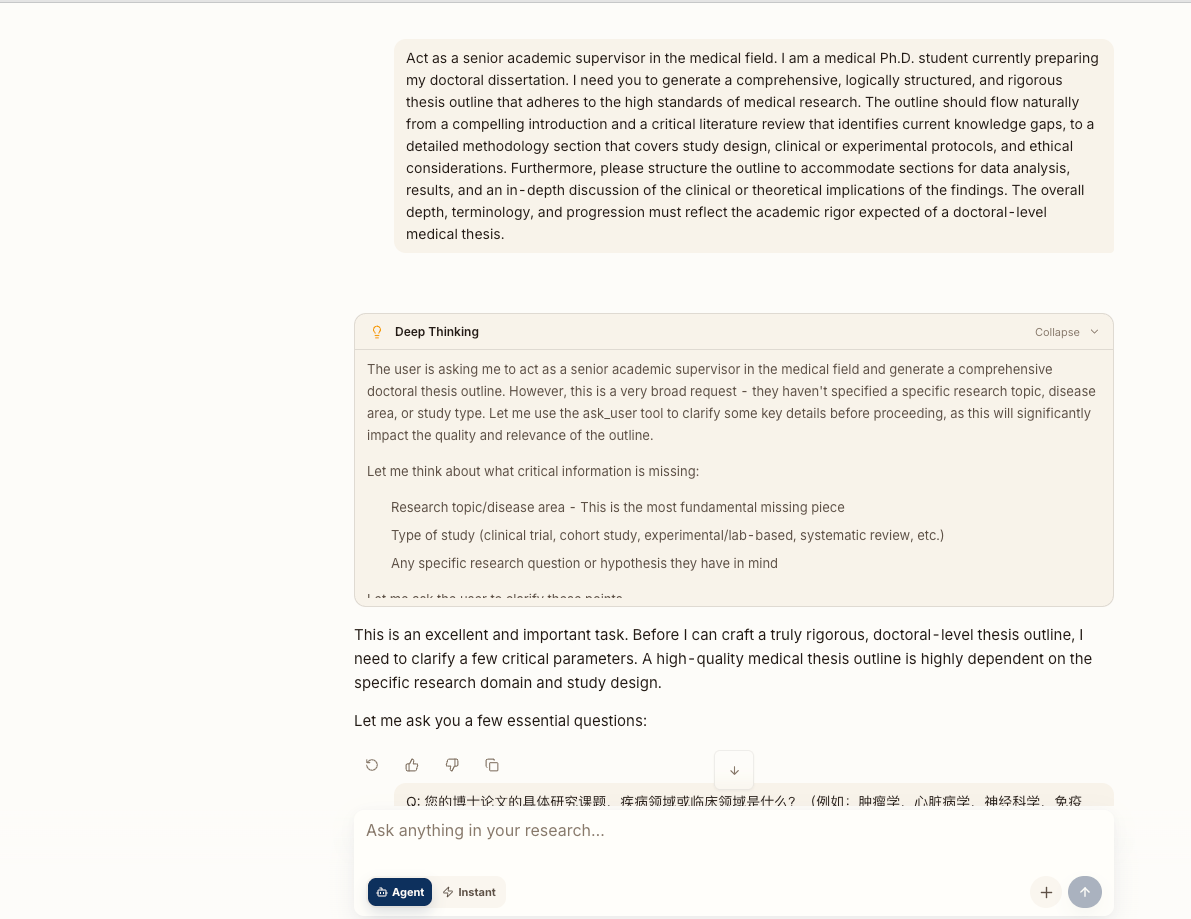
This screenshot supports one limited claim: the interface can request additional task context. It does not prove that Acade provides medical supervision, validates an IRB protocol, or produces a compliant dissertation.
Authorship and disclosure
The International Committee of Medical Journal Editors states that AI-assisted technologies should not be listed or cited as authors because they cannot accept responsibility for accuracy, integrity, and originality. Human authors must review AI-assisted material and disclose relevant use. (ICMJE: Use of AI by Authors)
Disclosure rules differ by publisher and task. A defensible disclosure should identify:
- the tool and, when relevant, version or access date;
- the purpose for which it was used;
- the material or workflow stage affected;
- the human verification performed;
- confirmation that accountable human authors approved the final work.
Example disclosure for literature-search assistance
The authors used Acade on [date] to help develop search concepts and organize candidate literature records. All database searches were executed and documented by the authors. The authors independently verified bibliographic metadata, read the included sources, made all screening decisions, and approved the final manuscript.
Example disclosure for language support
Acade was used to suggest English-language edits to an author-written draft. The authors reviewed and approved every change and remain responsible for the final text.
These are drafting examples, not universal publisher-approved wording. Follow the target journal’s instructions.
Confidentiality, privacy, and peer review
ICMJE describes submitted manuscripts as privileged communications and cautions reviewers against uploading them to AI systems when confidentiality cannot be assured without permission. (ICMJE: Use of AI by Reviewers)
Do not upload protected health information, identifiable participant data, controlled-access datasets, unpublished third-party manuscripts, confidential peer-review files, or proprietary research unless the data owner and responsible institution explicitly authorize the exact system and workflow.
Removing a person’s name may not be sufficient. Rare conditions, dates, locations, images, genomic data, or combined variables may still make a participant identifiable.
Responsibility boundaries by user type
Undergraduate students
Check the assignment and instructor’s policy before using AI. A university may allow brainstorming but prohibit AI-generated answers. Keep a record of prompts and revisions when disclosure may be required.
Graduate students
Discuss AI use with the supervisor and follow thesis, data-management, and research-integrity rules. Do not let AI create an argument or “original contribution” that you cannot explain and defend.
Physicians and medical researchers
Separate research support from patient care. Acade may help organize published literature, but it is not a diagnostic or treatment system. Apply privacy, IRB, clinical, institutional, and publisher requirements.
Faculty, reviewers, and editors
Protect unpublished work and student information. Reviewers should obtain journal permission before using AI when required and must not transfer confidential manuscripts into unapproved systems.
What the free version does not change
Free access may allow users to evaluate bounded Acade tasks, subject to current Credits and plan limits. Citation and Knowledge Base availability must be described only according to the current plan.
No free or paid plan changes the human responsibility boundary. A plan does not guarantee correct citations, eliminate hallucinations, establish compliance, or make AI an author. Pricing and features may change; check the current Acade app and official pricing information.
Frequently asked questions
Is using AI for a literature search plagiarism?
Not automatically. The answer depends on policy, disclosure, and what is submitted. Presenting AI-produced analysis or prose as entirely your own may violate academic-integrity rules even if search assistance is allowed.
Do I need to disclose Acade?
Follow the instructor, institution, funder, and target publisher. When disclosure is required, describe the actual task and human verification rather than writing only “AI was used.”
Can AI be a research-paper author?
No. AI cannot meet accountability requirements for authorship.
Can I upload an unpublished manuscript?
Not unless you have authorization and the applicable confidentiality policy permits the specific system and use.
Is it okay for doctors to use AI for medical research?
It may be permissible for approved research-support tasks, but not as a substitute for clinical judgment, privacy safeguards, IRB oversight, or evidence appraisal.
Does Acade guarantee citation correctness?
No. Researchers must verify every citation against an authoritative record and the original source.
Decide first, then delegate a bounded task
I am a [student/researcher/physician] working under [course, institutional, funder, or journal policy]. I want to use Acade for [specific task]. The information involved is [public/confidential/controlled], and the output will be used for [purpose]. Help me identify what I must verify, document, and disclose before proceeding. Do not make a compliance decision for me.
Tell Acade your research background, goal, and constraints, then ask it to work with you on the next permitted task: open Acade.