
Chicago Manual of Style 18th Edition: How to Cite Sources Correctly

Written by Elena BrooksLast updated: August 11, 202620 min read

Quick Answer
The Chicago Manual of Style 18th edition supports two citation systems. Notes and Bibliography uses numbered footnotes or endnotes and usually a bibliography; it is common in history, literature, and the arts. Author-Date uses parenthetical citations such as (Author Year, page) and a matching reference list; it is common in the sciences and social sciences. Follow the system required by your instructor, department, publisher, or journal—do not combine the two without an explicit reason.
To create a Chicago 18 citation:
Confirm whether you must use Notes and Bibliography or Author-Date.
Identify the source type and collect authoritative metadata.
Create the appropriate note or parenthetical citation.
Create the matching bibliography or reference-list entry.
Verify every name, title, date, page, DOI, URL, and claim against the original source.
Acade can help you generate a working Chicago citation, understand why it follows a particular rule, and organize references with research notes and claims. It cannot guarantee that imported metadata is correct or that a source supports your interpretation. Human verification remains required.
Choose Your Chicago System
If your assignment or field requires… | Use | Citation in the text | End-of-paper list |
|---|---|---|---|
Footnotes or endnotes; flexible commentary on sources | Notes and Bibliography | Superscript note number | Bibliography, usually |
Brief author and year in parentheses | Author-Date | (Author Year, page) | Reference list |
Turabian for a student paper | Follow the assigned Turabian edition and local instructions | Depends on the selected system | Bibliography or reference list |
No system is specified | Ask the instructor, editor, or journal | Do not choose solely from personal preference | Follow the confirmed requirement |
The central rule: select one Chicago system first, then keep the citation form, source record, and supporting evidence consistent throughout the manuscript.
Research smarter with Acade
One Academic Agent for literature search, research design, writing, and more.
Try Start free →Need a Chicago 18 Citation Now?
Gather the source metadata before opening a generator:
Author or responsible organization
Publication or update date
Title and subtitle
Journal, book, website, publisher, or container title
Volume, issue, page range, or chapter details when applicable
DOI, stable URL, or archive information
The exact page or location supporting your claim
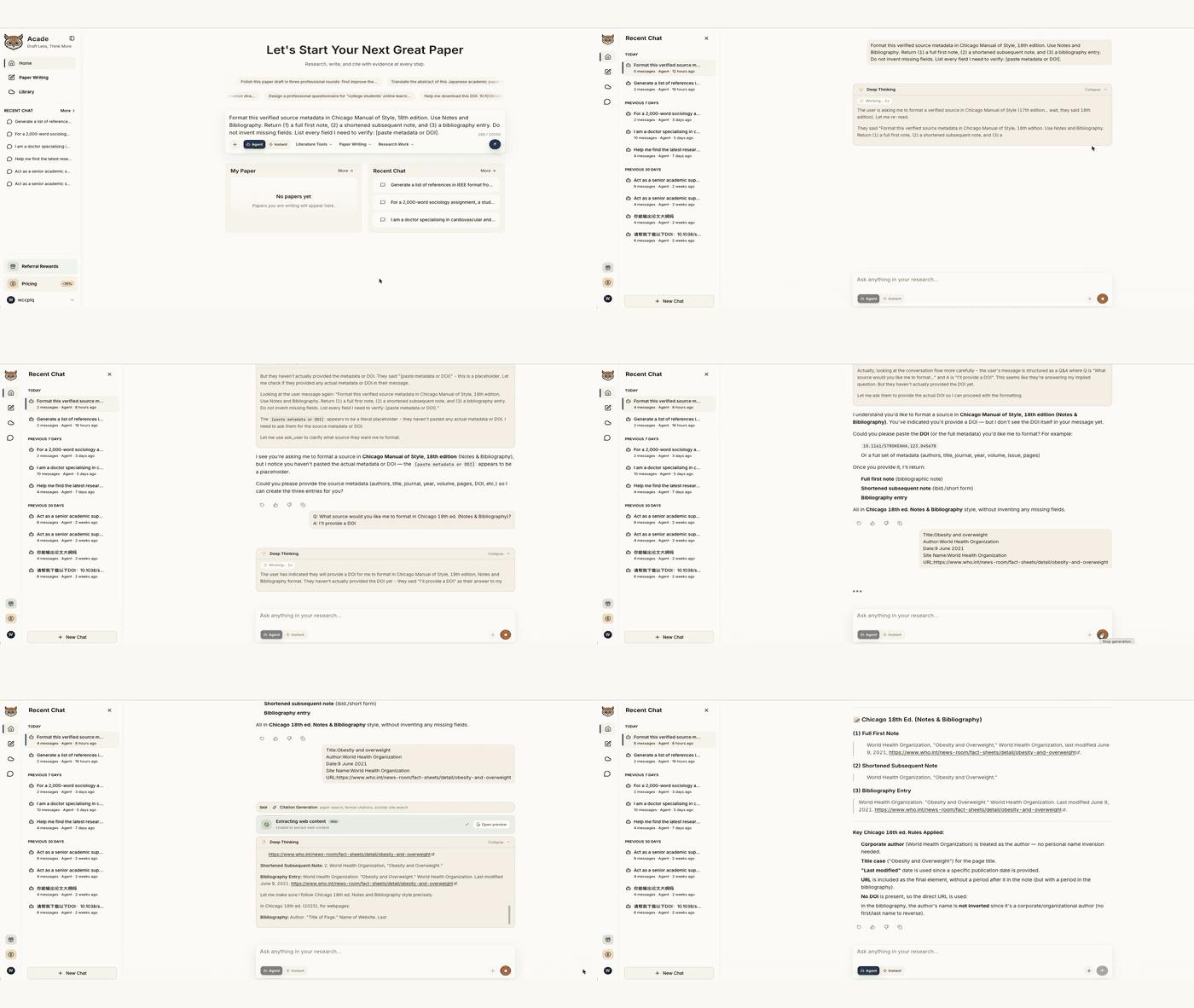
Then give Acade a bounded task:
Format this verified source metadata in Chicago Manual of Style, 18th edition. Use Notes and Bibliography. Return (1) a full first note, (2) a shortened subsequent note, and (3) a bibliography entry. Do not invent missing fields. List every field I need to verify: [paste metadata or DOI].
For Author-Date, change the request to:
Use Chicago 18 Author-Date. Return (1) a parenthetical citation for the specific page and (2) the matching reference-list entry. Do not guess missing information.
Acade’s official product information includes automatic citation and referencing within its academic workflow. Treat the result as a working record, not as final authority. Use the Chicago-Style Citation Quick Guide and the Chicago Manual of Style, 18th edition, to verify the format. Acade’s current scope should be checked on its official website.
Tell Acade which Chicago system you need and generate a citation you can verify →
What the Purdue OWL Page Covers—and What It Does Not
The linked Purdue OWL page is a useful introduction, but its title and content explicitly address the 17th edition. If your instructor, department, journal, publisher, or existing manuscript specifically requires that edition, use the Chicago Manual of Style 17th edition citation and migration guide.
If your instructions require the latest Chicago style, continue with this Chicago 18 guide.
Its structure is straightforward:
It introduces Chicago as a broader editorial and publication manual.
It distinguishes Notes and Bibliography from Author-Date.
It focuses primarily on Notes and Bibliography.
It explains notes, shortened notes, bibliographies, author names, titles, publication information, and punctuation.
It links to source-specific examples and sample papers.
That structure is effective for orientation, but it is not sufficient for a page promising current Chicago 18 guidance. It gives limited task support for choosing between the two systems, handling the 18th-edition changes, validating imported metadata, or managing citations across a research project. The Purdue OWL overview should therefore be treated as a secondary teaching resource, not the controlling authority for Chicago 18.
What Changed in Chicago 18 Citations?
Not every rule changed. The two-system model remains: Notes and Bibliography uses numbered notes, while Author-Date uses parenthetical citations linked to a reference list. The changes below are especially relevant to students and researchers and are documented in the official Chicago 18 “What’s New” guide.
Revised treatment of multiple authors
Chicago 18 now lists up to six authors in a bibliography or reference-list entry. When there are more than six, list the first three followed by “et al.” In a note or Author-Date text citation, list up to two authors; for more than two, use the first author followed by “et al.”
Do not apply this rule to an existing reference library through a blind search-and-replace. First confirm how each source identifies its authors and preserve the publication order.
Repeated author names are written out
Chicago now prefers repeating the author’s name in successive bibliography or reference-list entries rather than replacing it with a 3-em dash. This improves accessibility and reduces ambiguity in digital documents.
Shortened citations are clarified
When a shortened note is used instead of “ibid.,” Chicago recognizes three forms depending on context: author–title, author only, or title only. The ordinary safe form is author plus a shortened title and locator. Choose a shorter form only when the reference is unambiguous.
Journal month or season may usually be omitted
A month or season can now usually be left out of a journal-article citation. Do not remove a date element when it is necessary to identify another source type, such as a newspaper article or time-sensitive webpage.
Book publication place is no longer required
Chicago 18 no longer requires the place of publication in book citations. The publisher remains relevant. This is a common point where older templates produce unnecessary information.
Edited-book chapter page ranges changed
The full page range for a chapter in an edited book is no longer required in a bibliography or reference-list entry. A locator is still used when a note or text citation points to a specific page, and page ranges remain required for most journal articles.
Eastern-order names are not normally inverted
Authors whose names follow an Eastern order—family name first—are not normally inverted in the bibliography or reference list. Do not assume every personal name follows the same Western given-name/family-name pattern.
New and expanded digital-source guidance
The 18th edition adds or expands guidance for preprints and ahead-of-print articles, archived web content, AI-generated content, Indigenous sources, databases, and datasets. These categories require source-specific judgment; a generic website template may be wrong.
AI use and disclosure receive greater attention
The official change list adds guidance on AI-generated content and on authors’ responsibility to state whether and to what extent AI was used. Citation and disclosure are related but not identical: citing an AI output does not automatically satisfy an institution’s disclosure policy, and disclosing AI assistance does not validate the output.
Notes and Bibliography: How the System Works
Notes and Bibliography is widely used in humanities fields because notes can identify sources and, where appropriate, add concise commentary. Every quotation, paraphrase, summary, data point, image, or borrowed idea that requires attribution should be connected to a note.
Place the note number correctly
Insert a superscript number after the sentence or clause containing the borrowed material, normally after punctuation. The number connects the statement to a footnote at the bottom of the page or an endnote at the end of a chapter or document.
Do not type note numbers manually if your word processor offers a footnote or endnote function. Automatic notes renumber when text is moved.
Create the first note
A full first note generally presents the author in normal order, the title, publication facts, and the specific page or locator used. Exact elements vary by source type.
Illustrative book pattern:
1. First Name Last Name, Title of Book (Publisher, Year), page.
This is a pattern, not a substitute for checking a source-specific Chicago 18 example.
Create a shortened subsequent note
For a source cited again, use a shortened form that clearly identifies it.
Illustrative pattern:
2. Last Name, Shortened Title, page.
Chicago accepts shortened forms instead of relying on “ibid.” An author-only or title-only form may work in an unambiguous context, but author–title is usually safer in a paper with many sources.
Build the bibliography entry
Bibliography entries normally invert the first author’s Western-order name and arrange sources alphabetically. Major elements are generally separated by periods. Titles of books and journals are italicized; titles of articles and chapters are placed in quotation marks.
Illustrative book pattern:
Last Name, First Name. Title of Book. Publisher, Year.
Notice that the bibliography format is not simply a copy of the footnote. Name order and punctuation differ.
Is a bibliography always required?
Notes and Bibliography usually includes a bibliography, but Chicago can permit notes without a bibliography when the notes contain sufficient information. Student assignments, theses, departments, and publishers may impose stricter requirements. Follow the instructions you were given rather than omitting the bibliography because the general style sometimes allows it.
Author-Date: How the System Works
Author-Date places a brief citation directly in the text and matches it to a reference-list entry. It emphasizes both the researcher and the publication date, which is useful in fields where the age of evidence matters.
Create the parenthetical citation
General pattern:
(Author Year, page)
Chicago Author-Date normally does not place a comma between author and year, but it does use a comma before the page locator.
Illustrative sentence:
Explicit source-evaluation procedures can strengthen evidence use in student writing (Rivera 2024, 57).
The author and publication details are illustrative, not a real source.
Use the author in the sentence when useful
If the author is part of the sentence, place the year and locator in parentheses as appropriate.
Rivera (2024, 57) describes source evaluation as a separate step from citation formatting.
Build the reference-list entry
The publication year appears near the author’s name in an Author-Date reference. This placement distinguishes it from Notes and Bibliography.
Illustrative book pattern:
Last Name, First Name. Year. Title of Book. Publisher.
Do not label an Author-Date end list “Bibliography” if your assignment requires “References” or “Reference List.” Follow the local specification.
Chicago 18 Formats for Common Source Types
The patterns below show which information to collect. They are not a complete substitute for the official source-specific examples.
Journal article
Collect the authors in publication order, article title, journal title, volume, issue, year, page range or article number, and DOI. Most journal articles still require a page range in the bibliography or reference list. Verify whether you are citing the version of record, an ahead-of-print version, or a preprint.
Book
Collect the author or editor, title and subtitle, edition, publisher, year, and stable identifier when applicable. Chicago 18 does not require the city of publication. Do not import an old template that automatically adds it.
Chapter in an edited book
Distinguish the chapter author from the book editor. Record the chapter title, book title, editor, publisher, and year. Chicago 18 no longer requires the chapter’s full page range in the bibliography or reference-list entry, though a specific page remains relevant when citing a passage.
Webpage
Identify a real author or responsible organization, page title, website title, publication or revision date, and stable URL. A site-wide copyright date is not necessarily the page date. Add an access date when Chicago or your publisher requires it for material without a reliable date or content likely to change.
News article
Capture the author, headline, publication, full publication date, and URL or database information. Do not treat a news article as a scholarly journal article merely because it appears in an online database.
Report
Identify the individual or organization responsible for the report, title, report number if applicable, publisher, year, and DOI or URL. Check the report’s title page instead of relying only on its download page.
Thesis or dissertation
Record the author, title, degree type, institution, year, database or repository, and identifier or URL. Confirm whether you are citing a published database record, an institutional-repository copy, or an unpublished manuscript.
Dataset
Capture the creator, title, version, repository or publisher, date, DOI, and any subset or access details necessary to reproduce the use. A dataset citation does not replace a methods explanation of how the data were selected and analyzed.
AI-generated content
Chicago 18 adds guidance for AI-generated content, but the correct treatment depends on whether the output can be retrieved, what role it played, and what the institution or publisher requires. Do not list an AI system as a human author. Preserve relevant prompts or transcripts when policy or reproducibility requires them, protect confidential data, and disclose AI assistance separately when required.
A Seven-Step Chicago Citation Workflow
Step 1: Confirm the required system
Check the assignment sheet, departmental handbook, thesis template, journal instructions, or editor’s style sheet. “Use Chicago” is incomplete unless the expected system is clear.
Completion standard: You can state “Chicago 18 Notes and Bibliography” or “Chicago 18 Author-Date.”
Step 2: Open the authoritative source record
Use the publisher page, DOI record, book title page, library catalog, repository, or official report. Search snippets and AI summaries can omit or alter metadata.
Common error: citing a database landing page instead of the work itself.
Step 3: Capture complete metadata
Preserve author order and name form. Record the publication version, date, title, container, publisher, pages, DOI, URL, and access information needed for that source type.
Completion standard: Missing fields are explicitly marked rather than guessed.
Step 4: Identify the exact claim and locator
Determine whether you are quoting, paraphrasing, summarizing, or citing a whole work. Record the page, section, timestamp, figure, table, paragraph, or other locator that lets a reader inspect the evidence.
Step 5: Generate the working citation
Give the verified metadata and selected system to Acade. Ask for only the formats you need and require a missing-field warning.
Notes and Bibliography prompt:
Use Chicago Manual of Style, 18th edition, Notes and Bibliography. Create a full first note, a shortened note, and a bibliography entry. Preserve author order and do not invent missing information.
Author-Date prompt:
Use Chicago Manual of Style, 18th edition, Author-Date. Create the parenthetical citation for page [x] and the matching reference-list entry. Flag every uncertain field.
Step 6: Compare with an official Chicago 18 example
Check name order, number of displayed authors, punctuation, title treatment, date placement, page range, DOI or URL, and the distinction between note and bibliography forms. Do not validate Chicago 18 output solely against a 17th-edition page.
Step 7: Audit the manuscript
Confirm that every note or parenthetical citation points to the intended source, every end-list entry matches its citations, and every source supports the claim. Check the document globally for accidental mixing of the two systems.
Generate Citations, Understand Rules, and Manage References With Acade
Acade can support Chicago citation as one part of a broader research workflow. Its value is not limited to punctuation: users can connect sources, notes, claims, outlines, and working references while moving from literature research to drafting.
Generate a citation immediately
Provide the source type, selected Chicago system, and verified metadata. Ask Acade for the first note and shortened note plus bibliography entry, or the Author-Date citation plus reference-list entry.
Understand the rule instead of copying blindly
Use a follow-up request:
Explain why the author name is ordered differently in the note and bibliography, why this title is italicized or placed in quotation marks, where the year appears, and which Chicago 18 change affects this entry.
The explanation can teach the pattern, but verify it against Chicago’s official guide when the work is graded, submitted as a thesis, used in clinical or policy research, or prepared for publication.
Manage references around evidence
Ask Acade to create a research control table:
Source ID | Citation system | Verified metadata | Claim supported | Locator | Working citation | Verification status |
|---|
This table helps prevent three common problems: a source in the bibliography that is never used, a footnote with no verified record, and a citation attached to a claim the source does not support.
Acade can help organize this workflow, but do not claim it replaces all functions of Zotero, Mendeley, EndNote, or another dedicated reference manager unless those exact requirements have been tested in the current product. Specialized managers may offer browser capture, deduplication, attachment storage, shared libraries, and word-processor plugins.
Build a cited outline
After verification, ask:
Use only the verified records in this table. Map each source to the claim it can support, identify unsupported sections, and format the working citations in Chicago 18 Notes and Bibliography. Do not create new sources.
This keeps citation work connected to evidence and argument rather than treating the bibliography as a decorative final step.
Worked Example: Choosing the Correct Chicago System
This is an illustrative workflow and does not invent a real publication.
Scenario: A graduate student is writing a history paper that requires Chicago 18 footnotes and a bibliography.
Available source record:
Author:
[copy from title page or publisher record]
Title:
[verify title and subtitle]
Publisher:
[verify]
Year:
[verify]
Cited page:
[verify against the book]
Stable record:
[library, publisher, DOI, or other identifier]
Acade task:
My department requires Chicago 18 Notes and Bibliography. From these verified fields, create a full first footnote, a shortened later footnote, and a bibliography entry. Do not add a publication city. Explain the author-name order, title treatment, punctuation, and locator. Mark missing fields instead of guessing.
Expected intermediate output:
Selected system confirmation
Full first note
Shortened note
Bibliography entry
Missing-field warning
Rule explanation
Verification checklist
Human verification:
Compare the author and title with the book’s title page.
Confirm publisher and year.
Open the cited page and verify the quotation or paraphrase.
Check that no publication place was imported from an older template.
Compare the result with a Chicago 18 book example.
Test the note number and bibliography formatting in the final document.
The task is complete only when the citation identifies the correct work, the locator reaches the supporting passage, and the manuscript consistently uses Notes and Bibliography.
Common Chicago 18 Citation Errors
Error | Why it happens | Correction |
|---|---|---|
Notes and Bibliography is mixed with Author-Date | “Chicago” was treated as one format | Confirm one system before drafting |
A 17th-edition template is assumed to be current | An older university guide ranks well in search | Verify changed rules with Chicago 18 |
Too many or too few authors are displayed | Software uses an older author threshold | Apply the Chicago 18 author rule |
Publication city appears in a book citation | Old templates still include it | Remove it under Chicago 18 unless a local rule says otherwise |
A 3-em dash replaces repeated author names | Library data follows an older convention | Repeat the author name |
The bibliography entry is copied directly from the note | Note and bibliography punctuation differ | Generate and check each form separately |
“Ibid.” is used repeatedly | Old examples were copied | Prefer a clear shortened citation |
DOI or page locator is invented | Metadata was incomplete | Return to the authoritative source record |
Citation format is correct but the claim is unsupported | Only punctuation was audited | Read the source and revise the claim |
Chicago 18 Reference-Management Checklist
[ ] The required Chicago system has been confirmed.
[ ] Notes and Author-Date citations are not mixed accidentally.
[ ] Every quotation, paraphrase, summary, dataset, image, or borrowed idea is attributed where required.
[ ] Author names and order match the original source.
[ ] Chicago 18 author-count rules are applied.
[ ] Full and shortened notes identify the correct source.
[ ] Parenthetical citations match reference-list entries.
[ ] Notes match bibliography entries where a bibliography is required.
[ ] Book citations do not automatically include a publication city.
[ ] Journal articles retain required page ranges.
[ ] Chapter page ranges are treated according to Chicago 18.
[ ] DOI and stable URLs resolve to the intended source.
[ ] Every locator reaches the evidence being cited.
[ ] AI-generated metadata and citations have been checked manually.
[ ] Course, university, hospital, funder, and publisher rules have also been followed.
Frequently Asked Questions
What are the two Chicago citation systems?
Chicago uses Notes and Bibliography, based on numbered footnotes or endnotes, and Author-Date, based on parenthetical author–year citations. Both connect citations to fuller source records, but their placement and punctuation differ.
Is Chicago 18 the latest edition?
Yes. The official Chicago website currently presents the 18th edition and documents its changes. A page labeled “17th edition,” including the linked Purdue OWL overview, should not be treated as the final authority for changed rules.
Should I use footnotes or Author-Date citations?
Use the system required by your instructor, department, journal, or publisher. Notes and Bibliography is common in humanities fields; Author-Date is common in sciences and social sciences, but local requirements take priority.
What is the difference between a footnote and a bibliography entry?
A footnote connects a specific statement to a source and often includes a page locator. A bibliography entry identifies the work in an alphabetized end list. The name order and punctuation are not identical.
Does Chicago 18 still require a publication city for books?
No. The official Chicago 18 change list states that a place of publication is no longer required in book citations.
How many authors are listed in Chicago 18?
In bibliography or reference-list entries, list up to six authors; for more than six, list the first three followed by “et al.” In notes and Author-Date text citations, list up to two; for more than two, use the first author followed by “et al.”
Can a Chicago citation generator be wrong?
Yes. It may choose the wrong system, import incomplete metadata, use 17th-edition rules, alter author order, or invent missing fields. Compare the result with the original source and an official Chicago 18 example.
Can Acade generate Chicago 18 citations?
Acade’s product information includes automatic citation and referencing. Users can supply verified metadata, specify Chicago 18 and the required system, and request the relevant note, parenthetical citation, bibliography, or reference-list entry. The result must still be verified.
Can Acade manage Chicago references?
Acade can help organize source metadata, notes, claims, outlines, and working citations within a research workflow. Do not assume it replaces every specialized reference-management feature unless that workflow has been tested in the live product.
How should AI-generated content be cited in Chicago 18?
Chicago 18 adds guidance on citing AI-generated content and on authors’ responsibility to explain AI use. The treatment depends on retrievability, context, and institutional or publisher policy. Do not identify AI as a human author, and do not upload confidential research or patient data without authorization.
Is Turabian the same as Chicago 18?
Turabian is adapted for student research papers and follows Chicago’s two broad documentation systems, but its edition and student-paper instructions may differ. Follow the Turabian edition or institutional template you were assigned rather than assuming every Chicago 18 publishing rule applies unchanged.
Final Takeaway
Chicago 18 citation begins with a decision, not a punctuation mark: choose Notes and Bibliography or Author-Date. Then connect every borrowed claim to verified source metadata, the correct citation form, an appropriate locator, and a consistent bibliography or reference list.
Acade can help users generate the working citation, understand the rule, and manage references alongside evidence and drafting. The student, researcher, clinician, teacher, or author remains responsible for source verification, interpretation, originality, confidentiality, disclosure, and final submission.
Give Acade Your Next Chicago Citation Task
Tell Acade which Chicago 18 system your institution requires, what source you are citing, how you use it, and which fields are uncertain. Ask it to generate the correct citation forms, explain the rule, and return a field-by-field verification checklist.
Generate and verify your next Chicago 18 citation with Acade →
About the author
Elena Brooks
Academic Research Content Editor at Acade
Elena Brooks is an Academic Research Content Editor at Acade. She creates practical, evidence-informed content about literature research, research design, academic writing, and the responsible use of AI in scholarly work. She works with Acade’s product team to evaluate research workflows, verify product capabilities, and translate complex academic processes into clear guidance for students and researchers.
Research smarter with Acade
One Academic Agent for literature search, research design, writing, and more.
Try Start free →No credit card required.